
The Kuiper Belt always catches my interest because it’s like a mysterious outer border of our solar system filled with frozen leftovers from when the planets first formed. If you’ve ever wondered where the Kuiper Belt actually is, what’s hanging out there, or why it matters, you’re not alone. Here, I’m going to break down where the Kuiper Belt is, what it contains, and why astronomers keep talking about it.
Where the Kuiper Belt Sits in Our Solar System
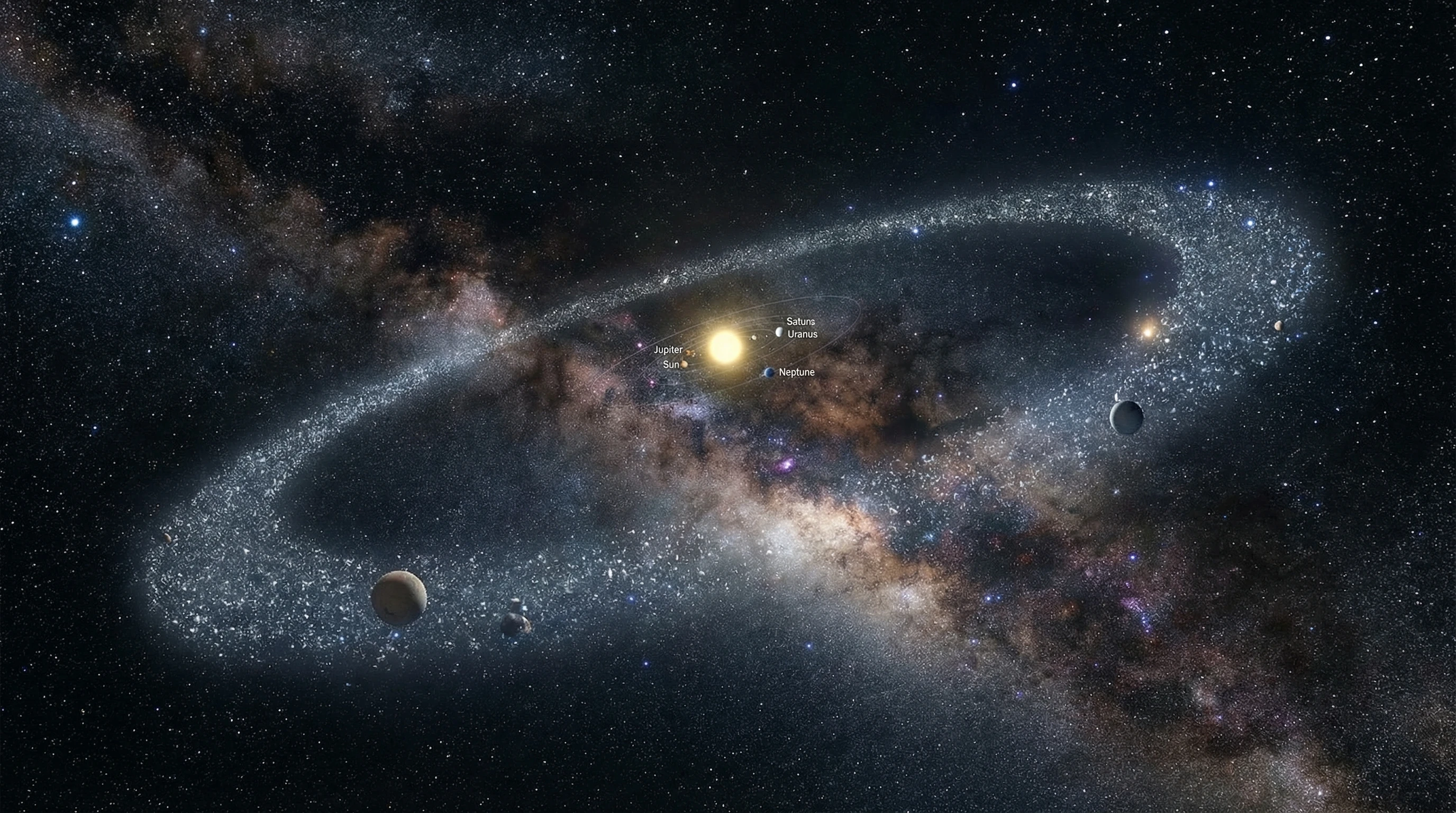
The Kuiper Belt is a vast ring shaped zone of icy objects that’s well past Neptune’s orbit. If you start at the Sun, you’d head out past Mercury, Venus, Earth, Mars, Jupiter, Saturn, and Uranus. Then there’s Neptune, which orbits the Sun at about 30 astronomical units (AU)—one AU is the distance from Earth to the Sun. The Kuiper Belt starts just a bit further out from Neptune, spanning from about 30 AU to 50 AU. That’s roughly 4.5 to 7.5 billion kilometers from the Sun, which is incredibly far. Light itself takes hours to make the trip!
For comparison’s sake, Pluto, which is the most famous Kuiper Belt object, orbits at around 39 AU. That means Pluto’s right inside this icy belt, proving its status as a Kuiper Belt object (or KBO, which is what a lot of astronomers call them).
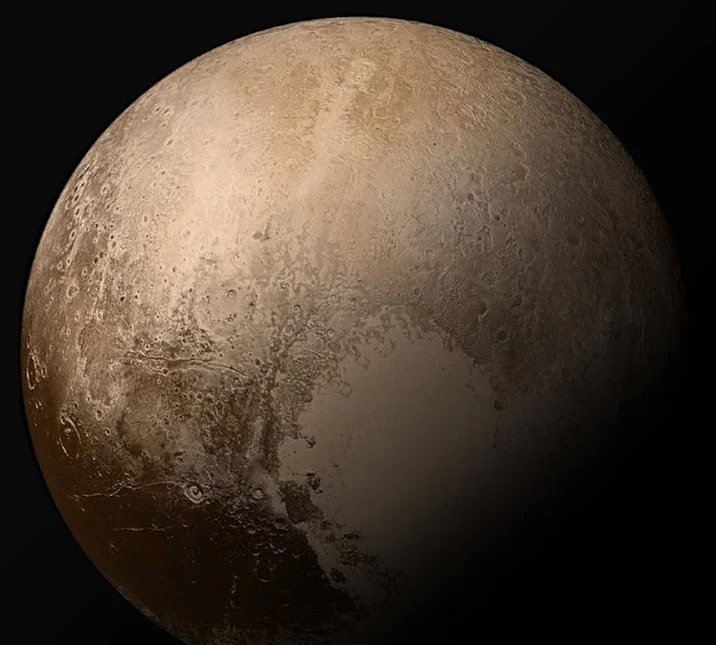 The Dwarf Planet Pluto. Picture New Horizons. NASA
The sheer scale is wild. It’s easy to imagine the planets neatly lined up, but once you get past Neptune, the emptiness is massive, then comes this scattered ring of icy bodies—the Kuiper Belt—wrapping around the edge of what we really know in the solar system.
How Astronomers Pinpointed the Kuiper Belt’s Location
There were clues of a distant belt in the solar system back in the mid-20th century, but nobody had seen it directly until the 1990s. Researchers predicted this area after noticing certain comets had really long orbits and odd tilts compared to the planets. Gerard Kuiper, for whom the belt is named, suggested in 1951 that a collection of icy bodies might exist out past Neptune, but it wasn’t proven until 1992 with the discovery of a KBO, called 1992 QB1. Since then, thousands of similar objects have been found in this area.
Locating the Kuiper Belt required big advances in telescope tech and imaging. These objects are dim, cold, and move very slowly compared to inner planets, so it took sensitive telescopes and lots of patience to find them. Telescopes like the Hubble Space Telescope and powerful ground based observatories played a big role.
Sometimes discoveries in the Kuiper Belt happen thanks to new image analysis software or improvements in tracking moving objects. As new technology emerges, astronomers keep scanning this distant zone and adding freshly found KBOs to the list.
What You’ll Find in the Kuiper Belt
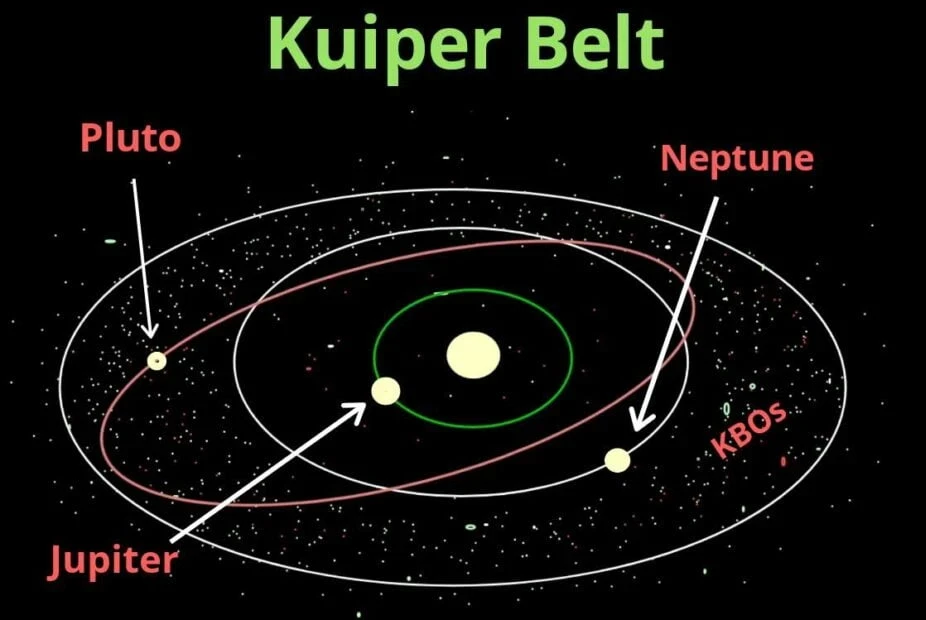 Graphic of the the location of the Kuiper Belt. KBOS = Kuiper Belt Objects.
This distant region has some weird and wonderful things drifting around. Here’s what populates the Kuiper Belt:
- Dwarf Planets: Pluto, Haumea, Makemake, and Eris all call the Kuiper Belt home. These are bodies that are big enough to be round due to their gravity but haven’t cleared their orbits of other debris.
- Frozen Rocks and Icy Fragments: Most objects are relatively small, ranging from just a few kilometers across to several hundred. They’re made up mostly of ice (including water, methane, and ammonia) and some rocky stuff mixed in.
- Comets: Many short period comets, which take less than 200 years to orbit the Sun, are thought to come from the Kuiper Belt. These icy objects get nudged towards the Sun by gravity, and as they heat up, they create bright tails visible from Earth.
Some astronomers believe there could be hundreds of thousands of mini-worlds hiding there, plus many more smaller icy fragments yet to be found. Some KBOs have moons of their own, while others travel in pairs, orbiting around a common point. All these icy bodies give us a taste of the solar system’s early history, preserved out in the cold.
Several KBOs show interesting colors and surfaces, pointing to the fact that chemical reactions can occur even far from the Sun. Some have reddish tints, perhaps from organic compounds building up over millions of years under cosmic rays—a cool detail that ties the Kuiper Belt to the study of prebiotic chemistry.
Quick Guide to the Kuiper Belt’s Edges and Boundaries
One thing I find pretty interesting is that the Kuiper Belt doesn’t have a hard outer edge. It sort of fades out as the number of objects drops. Here’s what you need to know about its boundaries:
- Inner Edge: Starts beyond Neptune’s path at 30 AU. Neptune’s gravity is strong enough to clear out or shuffle around objects any closer than this.
- Outer Edge: Trails off after about 50 AU. Beyond this, there are far fewer objects, and the even more distant Oort Cloud begins to take over, though that’s a way fuzzier, spherical area much farther out.
- Resonances: Several Kuiper Belt objects are locked into orbital “resonances” with Neptune. For example, Pluto orbits the Sun twice for every three Neptune orbits. This gravitational lock is why Pluto and some similar bodies don’t get flung out of their spots.
Inside these boundaries, orbits can get wild. Some KBOs, known as scattered disk objects, were tossed about by Neptune’s pull and now have elongated, tilted pathways. A few, like the detached population, have even stranger orbits that suggest something big—maybe a hidden planet—could be lurking out there influencing their paths. This is part of what keeps things so exciting for astronomers.
Why the Kuiper Belt Is So Interesting to Scientists
The Kuiper Belt isn’t just a distant ring of space debris; it’s almost like a time capsule from the birth of the solar system. Here are a few reasons it gets so much attention:
- Clues About Origins: Kuiper Belt objects are relatively unchanged since the early days of the solar system, so studying them gives clues about how planets and other bodies formed.
- Comet Activity: The comets that come from the Kuiper Belt help scientists understand how water and organic molecules might have made their way to the inner planets, possibly even Earth.
- The Search for Planet Nine: Some unusual orbits in the Kuiper Belt have scientists wondering if there’s another big planet lurking far beyond Neptune, which would influence these objects’ paths. This keeps researchers on the lookout for even bigger surprises.
If you’re into stargazing or just space in general, keeping up with new Kuiper Belt discoveries is pretty worthwhile, because unexpected things pop up there regularly.
Also, the ongoing comparison between Kuiper Belt objects and the asteroid belt’s makeup keeps fueling new theories about how our solar system switched things up over billions of years. Because KBOs are so well preserved, unlocking their secrets means peeking back at the earliest solar system chemistry and physics. Every new mission or telescope upgrade could reveal fresh details about how planets and possibly even life got started here.
Challenges in Studying the Kuiper Belt
Visiting or even observing the Kuiper Belt is a tall order. Here’s why:
- Distance: At 30-50 AU from the Sun, it takes spacecraft many years to even reach it. The New Horizons probe, which launched in 2006, took almost a decade to get to Pluto, a Kuiper Belt member!
- Size and Darkness: Objects are both tiny and very faint, making them really tough to spot from Earth, even with big telescopes.
- Extreme Cold: Temperatures in the Kuiper Belt hover around -220°C (-364°F), so spacecraft have to be designed to handle deep freezes and keep working reliably.
Despite all this, missions like New Horizons have given us close-up images and data from Pluto and farther out, totally changing what scientists thought they knew about this distant area.
Future exploration might involve robotic probes with improved cameras and spectrometers to check out KBO surfaces in greater detail. Some scientists dream of sending tiny, fast spacecraft to skim by multiple Kuiper Belt targets, gathering more data on these icy relics. These ideas are still mostly on the drawing board, but technology keeps pushing ahead.
How the Kuiper Belt Compares to the Asteroid Belt
It’s easy to mix up the Kuiper Belt and the asteroid belt, but there are some clear differences:
- Location: The asteroid belt is between Mars and Jupiter (about 2-3.2 AU from the Sun); the Kuiper Belt is way beyond Neptune.
- Makeup: The asteroid belt has mostly rocky or metallic objects, while the Kuiper Belt is home to frozen, icy bodies mixed with some rock.
- Size: The Kuiper Belt is much larger in both the area it covers and in the size of some of its objects—Pluto is bigger than any asteroid belt object.
The two belts together show just how dynamic and varied our solar system really is. Comparing the two helps us spot differences in how planets formed and where materials like water and metal ended up. It’s another reason scientists keep digging into both regions, looking for new clues about our cosmic neighborhood.
New Horizons Space Probe
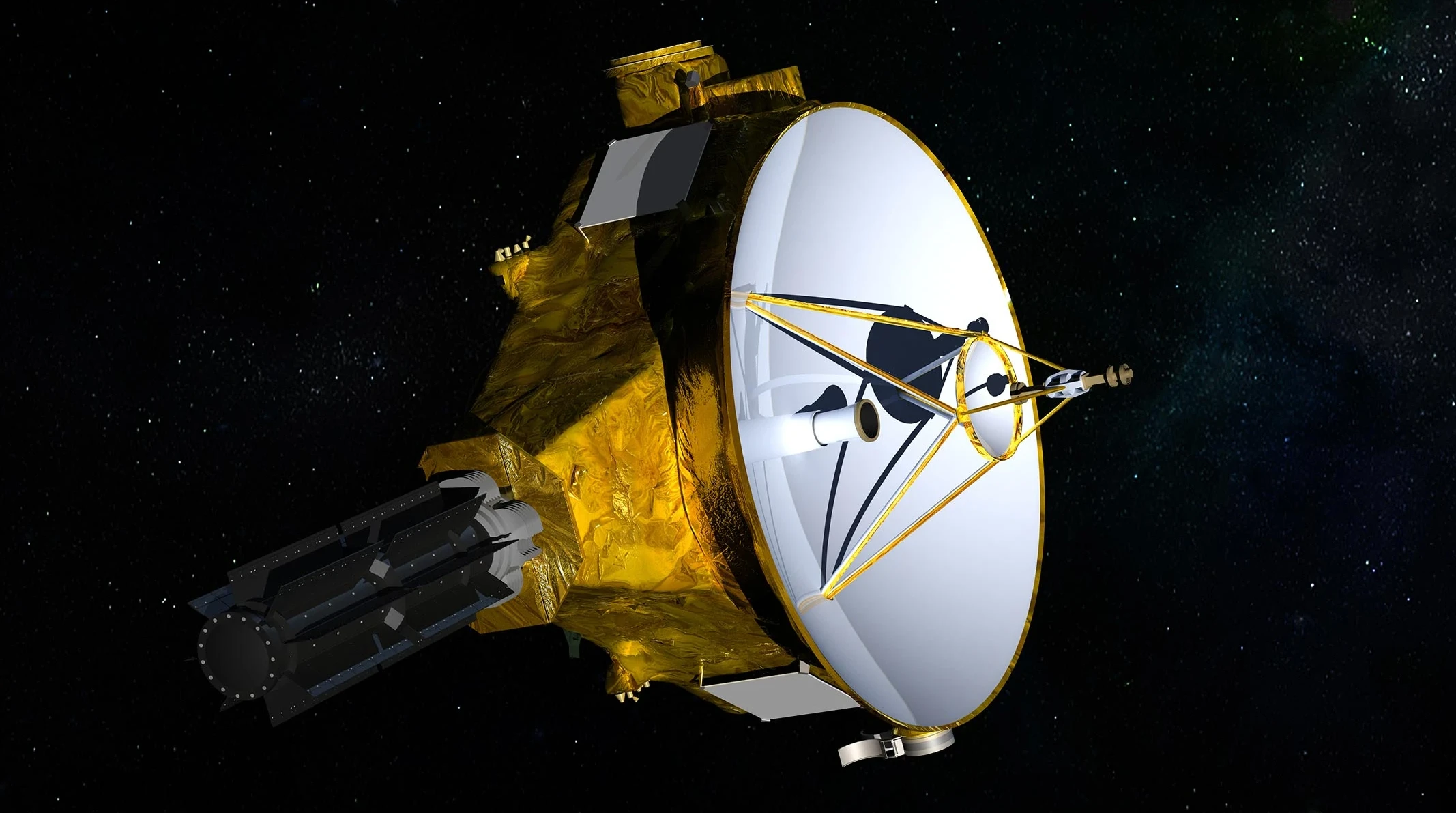 Artists impression of the New Horizons space probe.
Nothing that includes the dwarf planet Pluto and the Kuiper Belt cannot ignore the part that the New Horizons space probe has played in our understanding of the outer reaches of our Solar System.
Launched in 2006, New Horizons was planned as a fly-by of the last known planet yet to be explored in our Solar System, Pluto. Since New Horizons launch and the intervening years, Pluto was downgraded to a Dwarf Planet. This however did not mean the mission would be a damp squib. The mission planners decided they could redirect New Horizons to explore other Kuiper Belt objects which were being found by astronomers.
New Horizons reached Pluto in 2015. It photographed Pluto and its companion, Charon, in high quality. It also went on to photograph Pluto’s other moons, Nix and Hydra.
After the flyby of Pluto the mission operators decided to aim New Horizons towards the Kuiper Belt Object, 486958 Arroboth. New Horizons past this object in 2019.
New Horizon, all being well, is expected to be redirected to other Kuiper Belt Objects.
Frequently Asked Questions
I get some fun and usual questions whenever I talk about this topic. Here are a few common ones:
Question: Why isn’t Pluto counted as a planet anymore?
Answer: Pluto was reclassified as a dwarf planet in 2006 because it shares its orbit in the Kuiper Belt with other objects, meaning it doesn’t “clear” its orbit like the eight major planets.
Question: How far is the Kuiper Belt from Earth?
Answer: The Kuiper Belt starts at about 4.5 billion kilometers (30 AU) from the Sun, so it’s at least that far from Earth when we’re talking about its closest edge.
Question: Could life exist on Kuiper Belt objects?
Answer: The temperatures and conditions are extremely harsh, with almost no sunlight or warmth. While life as we know it would struggle, some scientists still watch for possible underground oceans or chemical activity on bigger objects like Pluto.
Bringing It All Together
The Kuiper Belt marks the far edges of the known solar system and adds a ton of mystery to what’s out there. From serving as Pluto’s neighborhood to being a source for comets and a time capsule for studying solar system history, the Kuiper Belt has a lot to offer for anyone fascinated by space. Whether it’s a future mission to one of its icy mini worlds or more discoveries using giant telescopes, fresh info about the belt keeps coming in, keeping us all guessing about what surprises still wait out there past Neptune.
Someday, new missions might put a lander on a KBO or even bring back a sample to Earth, letting us dig into Kuiper Belt materials up close. Until then, astronomers keep watching, and each year brings new finds that brighten up our understanding of this far flung frontier.
This was a fascinating and clear explanation of the Kuiper Belt, which many of us have heard of but often struggle to visualize. I had always been curious about its location in the solar system, and your post did an excellent job of clarifying that.
It’s incredible to think that beyond Neptune lies a vast ring of icy worlds, including Pluto and other dwarf planets, remnants from the early solar system. Knowing that the belt spans from about 30 to 50 astronomical units from the Sun really highlights the diversity of our cosmic neighborhood.
I’m particularly intrigued by how studying these distant objects can deepen our understanding of solar system formation, especially with missions like New Horizons exploring these icy bodies billions of miles away. What other secrets remain to be uncovered beyond Neptune?
Hello Leica and thank you for your comments.
The Kuiper Belt is a fascinating place with all sorts of objects there that we have yet to discover. One of those is Planet 9. From observations of Kuiper Belt Objects (KBOS) it is apparent that some of these distant objects are being affected by a large gravitation pull of a large object, approximately the size of Neptune or Uranus. Some astronomers have speculated that there could be even a planet 10 or 11 or more.
Beyond the Kuiper Belt is another belt called the Oort Cloud. This cloud is theorised to reach half the distance to the nearest star, Proxima Centauri, about 4.5 light years away. At the moment no object has yet been observed that shows itself as belonging to the Oort Cloud, so this cloud only exists as a theory but observations are continuing using the James Webb space telescope. Hopefully in the next few years we can prove one way or another that the Oort Cloud exists.
Dave