Buying your first telescope is exciting, but how to choose your first telescope, can be both exciting as well as daunting. Getting it right one can feel overwhelmed at first. With so many telescope types, sizes and features available, beginners often worry about buying the wrong equipment or spending money on something difficult to use.
The good news is that choosing your first telescope does not have to be complicated. Once you understand the basics, it becomes much easier to find a telescope that matches your budget, experience level and stargazing goals.
In this guide, you will learn what matters most when buying a beginner telescope, the differences between telescope types and how to avoid common mistakes many first-time buyers make.
What Should You Look For In A Beginner Telescope?
The best beginner telescope is not necessarily the biggest or most expensive one. A good starter telescope should be:
- Easy to set up
- Simple to use
- Portable enough to move comfortably
- Powerful enough to show clear detail
- Reliable and sturdy
Many beginners assume magnification is the most important feature, but this is not true. Telescope quality depends far more on aperture, optics and mount stability.
A telescope that is easy to use will help you spend more time observing and less time struggling with setup.
Understanding Telescope Aperture
Aperture refers to the diameter of the telescope’s main lens or mirror. This is one of the most important things to consider because it determines how much light the telescope can collect.
The larger the aperture:
- The brighter objects appear
- The more detail you can see
- The better faint deep sky objects become visible
For beginners, a telescope with an aperture between 70mm and 130mm is usually an excellent starting point.
Small telescopes are easier to handle and still provide impressive views of:
- The Moon
- Jupiter
- Saturn
- Star clusters
- Bright nebulae
If you want to learn more about what telescopes can actually show, read our What Can You See With A Telescope? guide.
The Main Types Of Telescopes
Refractor Telescopes
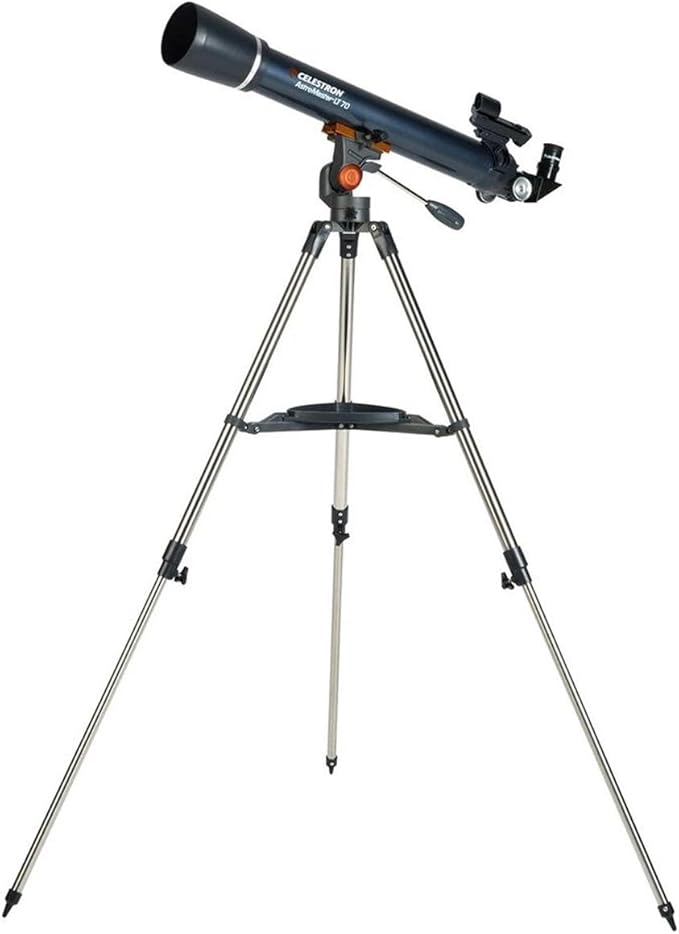
Refractors use glass lenses to gather light.
Advantages:
- Low maintenance
- Simple to use
- Excellent for Moon and planet viewing
- Durable and reliable
Disadvantages:
- Larger models can become expensive
- Usually narrower viewing fields
Refractors are often recommended for complete beginners because they are straightforward and dependable.
Reflector Telescopes
Reflectors use mirrors instead of lenses.
Advantages:
- Excellent value for money
- Larger apertures at lower prices
- Great for deep sky viewing
Disadvantages:
- Require occasional maintenance
- Can be bulkier
Dobsonian telescopes are one of the most popular beginner reflector designs because they combine simplicity with impressive viewing power.
Compound Or Catadioptric Telescopes
These telescopes combine lenses and mirrors into compact designs.
Advantages:
- Portable
- Versatile
- Good for both planets and deep sky observing
Disadvantages:
- More expensive
- More advanced for beginners
While excellent telescopes, they are often better suited for intermediate users rather than complete beginners.
Choosing The Right Telescope Mount
The mount supports the telescope and plays a major role in how enjoyable it is to use.
Alt-Azimuth Mounts
These move up, down, left and right.
Advantages:
- Simple to learn
- Ideal for beginners
- Quick setup
Dobsonian mounts are a popular example of this style.
Equatorial Mounts
These are designed to track objects as the Earth rotates.
Advantages:
- Helpful for astrophotography
- Better object tracking
Disadvantages:
- Steeper learning curve
- Longer setup times
For most beginners, a simple alt-azimuth mount is usually the best choice.
Should Beginners Buy A GoTo Telescope?
GoTo telescopes use computerized systems to locate celestial objects automatically.
These systems can be helpful, especially under light-polluted skies where stars are harder to identify. However, they also:
- Increase cost
- Require power sources
- Add complexity
Many beginners enjoy learning the night sky manually first before upgrading to GoTo systems later.
A simple telescope often helps beginners learn faster and build confidence more naturally.
Avoiding Common Beginner Telescope Mistakes
Choosing High Magnification Over Quality
Cheap telescopes often advertise extremely high magnification numbers. In reality, poor optics produce blurry images no matter how high the magnification goes.
Good optics and adequate aperture matter far more.
Buying A Telescope That Is Too Large
Huge telescopes sound exciting, but bulky equipment often becomes difficult to transport and store. A telescope you actually use regularly is far better than a giant telescope left indoors.
Ignoring The Mount
An unstable mount causes shaking and frustration. A sturdy mount is just as important as the telescope itself.
Expecting Hubble-Style Images
Real telescope views are different from long-exposure NASA images. However, seeing Saturn’s rings or Jupiter’s moons with your own eyes is still an unforgettable experience.
Accessories That Help Beginners
A few accessories can improve your stargazing experience significantly.
Helpful beginner accessories include:
- A red flashlight
- A star chart or astronomy app
- Extra eyepieces
- A moon filter
- Astronomy binoculars
You can also browse our Beginner Astronomy Accessories guide for more ideas.
Is A Telescope Better Than Binoculars?
Not always.
Binoculars are often one of the best starting points for learning the night sky because they are:
- Portable
- Affordable
- Easy to use
- Great for wide-field viewing
Many experienced astronomers still use binoculars regularly.
If you are completely new to astronomy, our Stargazing For Beginners guide is also a great place to start.
Frequently Asked Questions
What Is The Best Telescope For A Complete Beginner?
A small refractor or Dobsonian reflector is usually ideal for beginners because they are simple to use and provide excellent views.
How Much Should I Spend On My First Telescope?
Many excellent beginner telescopes fall between £150 and £500. Avoid extremely cheap department store telescopes, as they often disappoint.
Can You See Galaxies With A Beginner Telescope?
Yes, bright galaxies such as Andromeda are visible in beginner telescopes under dark skies, although they usually appear as faint glowing shapes rather than colourful photographs.
Is A Telescope Hard To Learn?
Not at all. Most beginners become comfortable using a telescope after only a few observing sessions.
If you are ready to start comparing actual beginner telescopes, see our guide to the Best Beginner Telescopes For Astronomy.
Final Thoughts
Choosing your first telescope is the beginning of an exciting journey into astronomy. The best beginner telescope is one that encourages you to spend more time outside exploring the night sky and less time struggling with complicated equipment.
Start simple, learn the sky gradually and focus on enjoying the experience. Even a modest beginner telescope can reveal stunning lunar craters, Saturn’s rings, Jupiter’s moons and countless star clusters.
Once you begin exploring the universe for yourself, it quickly becomes clear why astronomy is such a rewarding lifelong hobby.