The Perseids Meteor Shower 2026
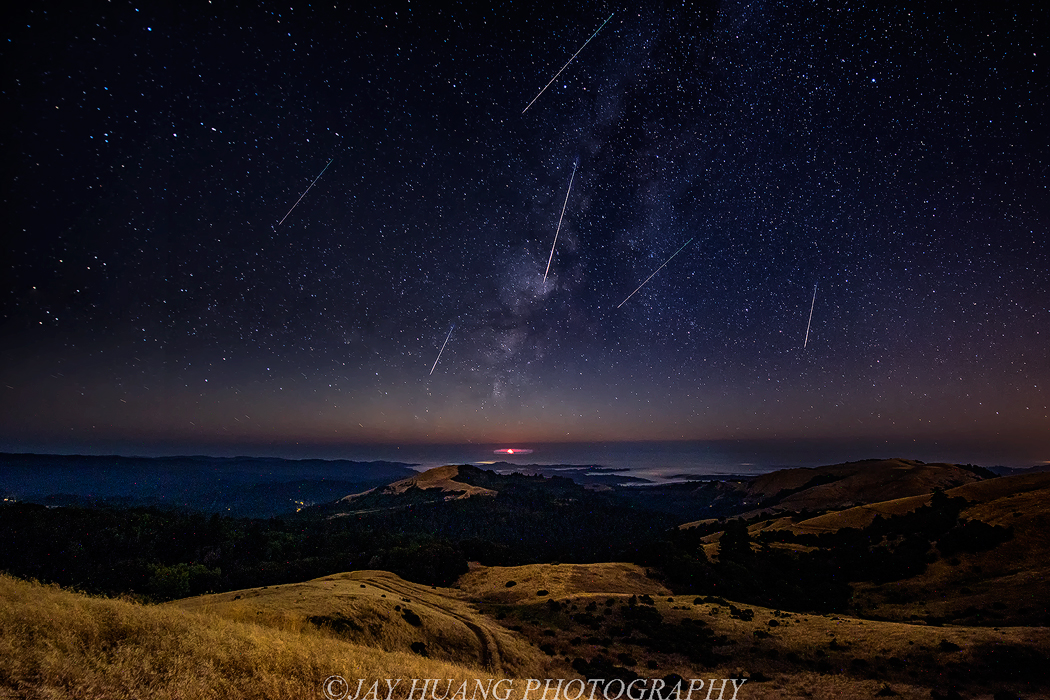
The Perseid meteor shower is one of the most popular and dependable astronomical displays of the year. During July and August, bright meteors can be seen streaking across the night sky as Earth passes through a stream of debris left behind by Comet 109P/Swift–Tuttle.
In 2026, the Perseids are active from approximately 17 July until 24 August. The shower is expected to reach its peak during the night of 12 August and the early hours of 13 August.
Conditions should be particularly favourable because the peak occurs close to a new Moon. With little moonlight to brighten the sky, faint meteors should be easier to see from dark observing locations.
The Perseids at a Glance
- Active period: Approximately 17 July to 24 August 2026
- Peak night: 12–13 August 2026
- Best observing period: Late evening on 12 August until dawn on 13 August
- Likely UK observing rate: Around 20–40 meteors per hour from a reasonably dark location, although actual rates vary considerably
- Maximum theoretical rate: Up to approximately 100 meteors per hour under ideal, very dark conditions with the radiant high in the sky
- Parent comet: Comet 109P/Swift–Tuttle
- Equipment required: None
- Moon conditions: Very favourable, with little interference from moonlight
No Telescope Is Required
Meteor showers are best observed with the naked eye. A telescope or binoculars will restrict your field of view and make it more difficult to notice meteors appearing across different parts of the sky.
Find a dark, open location, allow your eyes time to adjust and watch as much of the sky as possible.
What Is a Meteor Shower?
A meteor shower occurs when Earth passes through a stream of dust, grit and small pieces of rocky material orbiting the Sun.
When these particles enter Earth’s atmosphere at high speed, friction and compression heat the surrounding air. The particle and the air around it glow briefly, creating the streak of light commonly called a shooting star.
Most meteor particles are extremely small, often no larger than a grain of sand. They usually burn up high in the atmosphere and never reach the ground.
The particles in a meteor stream follow similar orbits around the Sun. As Earth crosses the stream, many meteors can appear during the same night.
What Causes the Perseid Meteor Shower?
The Perseid meteor shower is caused by material left behind by Comet 109P/Swift–Tuttle.
As a comet travels towards the inner Solar System, heat from the Sun causes frozen material on its surface to turn into gas. Dust and fragments of rock are released at the same time, forming a trail along the comet’s orbit.
Every year, Earth passes through part of Swift–Tuttle’s debris trail. The particles collide with Earth’s atmosphere and produce the bright streaks that we see as Perseid meteors.
Swift–Tuttle takes approximately 133 years to complete one orbit of the Sun. It last passed through the inner Solar System in 1992. The comet itself does not need to be near Earth for the annual meteor shower to occur because its debris remains spread along its orbit.
Other annual meteor showers are formed in a similar way. Most are produced by debris released by comets, although a small number are associated with asteroids or objects that may once have behaved like comets.
Why Are They Called the Perseids?
Meteor showers are normally named after the constellation from which their meteors appear to radiate.
If the paths of the Perseid meteors are traced backwards, they appear to meet in the constellation Perseus. This apparent point of origin is called the radiant.
The meteors are not physically coming from the stars of Perseus. The radiant is an effect of perspective, similar to the way parallel railway tracks appear to meet in the distance.
You do not need to look directly at Perseus to see the shower. Perseid meteors can appear anywhere in the sky, and those seen farther from the radiant often produce longer trails.
When Is the Best Time to Watch?
The Perseids can be observed for several weeks, but the greatest number of meteors is normally seen around the peak. In 2026, the main peak is expected during the night of Wednesday, 12 August into the early hours of Thursday, 13 August.
Meteors may be visible from the time the sky becomes properly dark. However, rates generally improve after midnight because the radiant rises higher and the observing side of Earth turns more directly into the incoming stream of particles.
The best period will probably be from around midnight until the beginning of morning twilight. Observers who cannot stay out all night should still have a reasonable chance of seeing meteors during the late evening.
Perseid activity does not suddenly begin and end at a particular time. Meteors can be seen on nights before and after the peak, although the hourly rate will usually be lower.
How Many Meteors Will You See?
From a reasonably dark site in the United Kingdom, an observer may see approximately 20–40 Perseid meteors per hour around the peak.
The actual number can vary greatly. Cloud, haze, nearby lighting, the observer’s eyesight, the height of the radiant and the amount of sky visible will all affect the result.
Reports of up to 100 meteors per hour normally refer to the shower’s zenithal hourly rate, often shortened to ZHR.
The ZHR is a calculated rate based on ideal conditions: perfectly dark skies, no cloud, an unobstructed horizon and the radiant positioned directly overhead. Most observers will see fewer meteors than this.
Meteor showers are also naturally uneven. Several meteors may appear within a few minutes, followed by a quiet period. Patience is therefore an important part of observing.
Fireballs and Lingering Trails
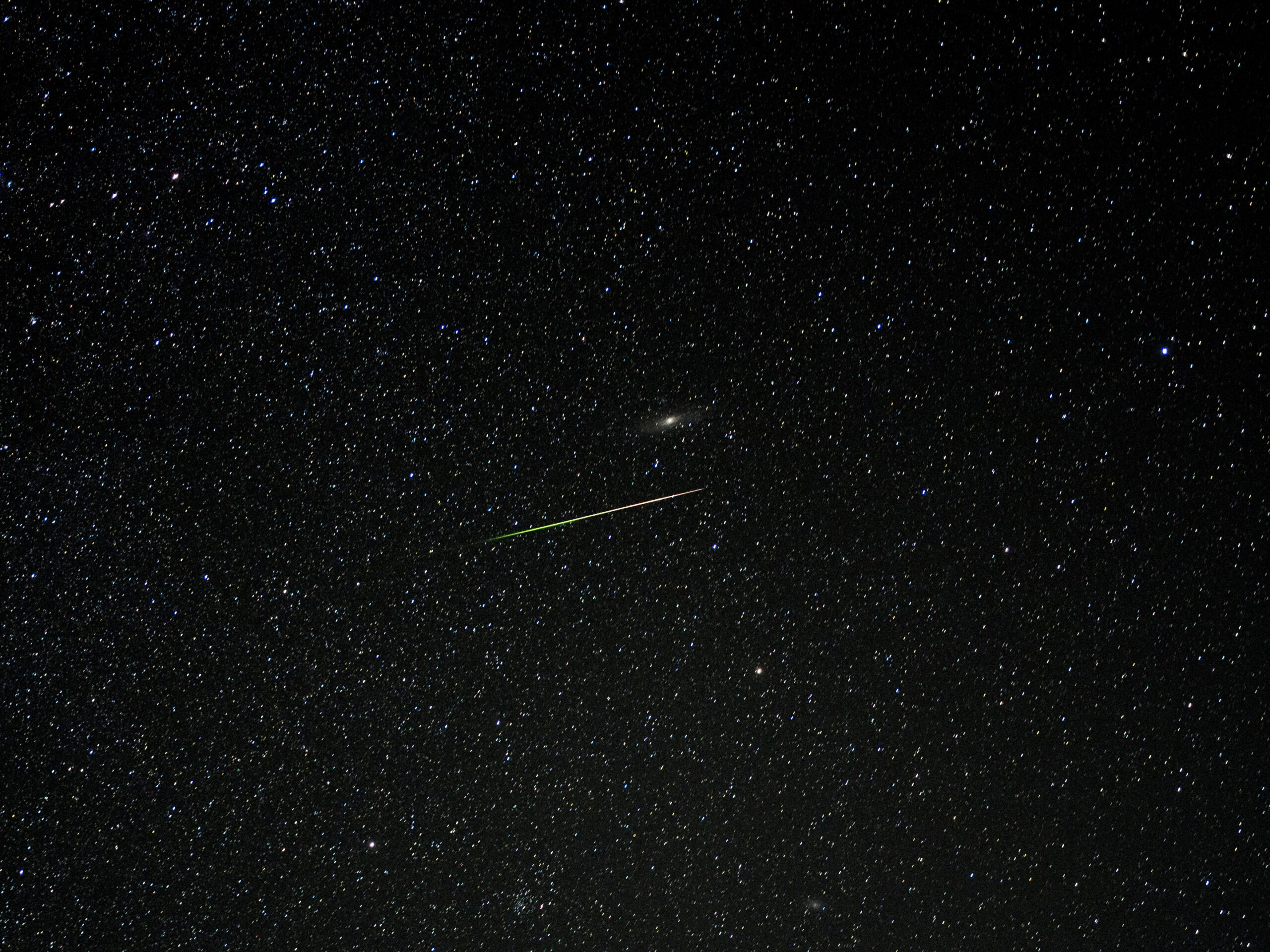
The Perseids are known for producing bright meteors, and occasionally an exceptionally bright one may appear.
A meteor brighter than most of the stars and planets is often called a fireball. A particularly bright fireball can briefly illuminate the surrounding sky or landscape.
Some Perseid meteors leave a glowing trail behind them. This is known as a persistent train and may remain visible for a second or two. Exceptionally bright meteors can leave trails that last longer and may appear to twist or drift in the upper atmosphere.
If you see a bright meteor, continue watching the position where it disappeared. Its trail may remain visible after the meteor itself has gone.
Choosing a Viewing Location
A dark observing site can make an enormous difference to the number of meteors you see.
Streetlights, security lighting, illuminated buildings and the glow from towns can hide faint meteors. Try to travel away from heavily lit areas and choose a location with a broad view of the sky.
An open field, quiet rural location, hilltop or recognised dark-sky site may provide suitable conditions. Make sure you have permission to use the location and visit it during daylight so that you can identify uneven ground, fences, water or other hazards.
Avoid standing directly beneath trees or close to tall buildings because these will block large sections of the sky.
If you must observe from a town or city, position yourself where nearby lights are hidden by a wall, fence or building. Even a small improvement in darkness may reveal additional meteors.
How to Observe the Perseids
Give your eyes at least 20 to 30 minutes to become properly adapted to the darkness. Avoid looking at phone screens, car headlights or white torches during this time.
A reclining garden chair or camping mat will allow you to look comfortably upwards without straining your neck. Position yourself so that you can see a wide area of sky.
Rather than staring directly at the radiant in Perseus, look approximately halfway between the radiant and the horizon. This increases the chance of seeing longer meteor trails.
Scan the sky gently rather than focusing on one particular star. Meteor observing works best when your vision is relaxed and your field of view is as broad as possible.
Use a dim red torch when you need to move around or check equipment. Red light generally interferes less with dark-adapted vision than bright white light.
Watching the Perseids as a Family
The Perseids are an excellent introduction to astronomy because no complicated equipment is needed. Children can take part by counting meteors or noting the direction in which each meteor travelled.
Choose a safe location, bring warm clothing and provide chairs or blankets. Even during August, temperatures can fall considerably during the night.
Younger children may not wish to stay awake until the early hours, but bright Perseids can still be seen during the late evening.
Children should remain under adult supervision, especially at rural viewing locations, near roads or in areas with uneven ground.
Photographing the Perseid Meteor Shower
Photographing meteors requires patience because it is impossible to know exactly where or when the next meteor will appear.
The most effective method is to use a camera capable of taking repeated long-exposure photographs.
Using a DSLR or Mirrorless Camera
Mount the camera securely on a tripod and use a wide-angle lens to capture a large area of sky.
Set the lens to manual focus and focus carefully on a bright star or distant light. Once focus has been achieved, avoid touching the focusing ring.
A starting exposure of approximately 10–20 seconds may be suitable, depending on the lens, camera and darkness of the sky. Use a wide aperture and increase the ISO until stars are recorded clearly.
Take a series of photographs using an interval timer or remote shutter release. The more frames you record, the greater the chance that a meteor will cross one of them.
Review your first few images and adjust the exposure if the sky appears too bright or the stars begin to form obvious trails.
Including the Landscape
A photograph can be made more interesting by including a tree, building, hill or other landmark in the foreground. Make sure the foreground does not block too much of the sky.
Compositions facing away from heavy light pollution will usually produce the darkest background and reveal more stars.
Using a Smartphone
Some modern smartphones include a night mode, manual mode or astrophotography setting. Mount the phone on a small tripod and use its widest camera lens.
Results will vary between phone models. A smartphone may record a bright fireball, but fainter meteors can be difficult to capture.
Avoid handholding the phone during a long exposure because even slight movement will blur the stars.
Weather and Preparation
Cloud cover is the greatest obstacle to meteor observing in the United Kingdom. Check several weather forecasts during the days leading up to the peak.
If the forecast for 12–13 August is poor, try observing on one of the nearby nights. The Perseids remain active before and after the main peak.
Prepare clothing, chairs, blankets, drinks and camera equipment before travelling. Charge batteries and clear memory cards in advance.
Take extra layers of clothing. Even if the evening begins warmly, remaining still beneath a clear sky for several hours can make observers feel cold.
Dew may form on cameras and lenses. A lens hood or suitable dew-heating band can help, although care should be taken not to disturb the camera once it is correctly positioned.
Perseid Meteor Shower Viewing Checklist
- Choose a safe location with dark skies and a broad, unobstructed view.
- Check the weather forecast before travelling.
- Observe during the night of 12–13 August for the expected peak.
- Begin watching after the sky becomes fully dark.
- Stay out after midnight if possible, when meteor rates should improve.
- Allow your eyes 20–30 minutes to adapt to the darkness.
- Avoid bright phone screens and white torches.
- Bring a reclining chair, blanket or camping mat.
- Wear warm clothing and bring an extra layer.
- Look at a wide area of sky rather than directly at Perseus.
- Do not use a telescope or binoculars for general meteor watching.
- Be patient. Meteor activity often comes in uneven bursts.
Final Thoughts
The Perseid meteor shower is one of the easiest astronomical events to enjoy. No telescope, binoculars or specialist knowledge is required. A dark sky, a comfortable chair and a little patience are enough.
In 2026, the peak during the night of 12–13 August should benefit from very little moonlight, giving observers a good opportunity to see both bright meteors and fainter streaks.
Although an observer in the United Kingdom may see around 20–40 meteors per hour from a good location, the display cannot be predicted exactly. A quiet period can suddenly be interrupted by several meteors or a brilliant fireball.
This unpredictability is part of the appeal. Every Perseid meteor is a tiny fragment of Comet Swift–Tuttle completing its journey in a brief flash of light above Earth.