Jupiter and Saturn: The Gas Giants
Jupiter and Saturn gas giants are two of the most spectacular planets in the Solar System, and they are also two of the most rewarding planets for a beginner to observe.
Both are enormous worlds made mainly of hydrogen and helium. Neither has a solid surface like Earth, Mars or Venus. Instead, their atmospheres become progressively denser and hotter with depth until the gases behave more like liquids under immense pressure.
They are also very different from one another visually. Jupiter is a world of colourful cloud belts, storms and rapidly changing weather. Saturn appears calmer from Earth, but is surrounded by the most spectacular ring system in the Solar System.
For somebody beginning practical astronomy, the good news is simple: you do not need an enormous telescope to enjoy either of them.
Jupiter: The King of the Planets
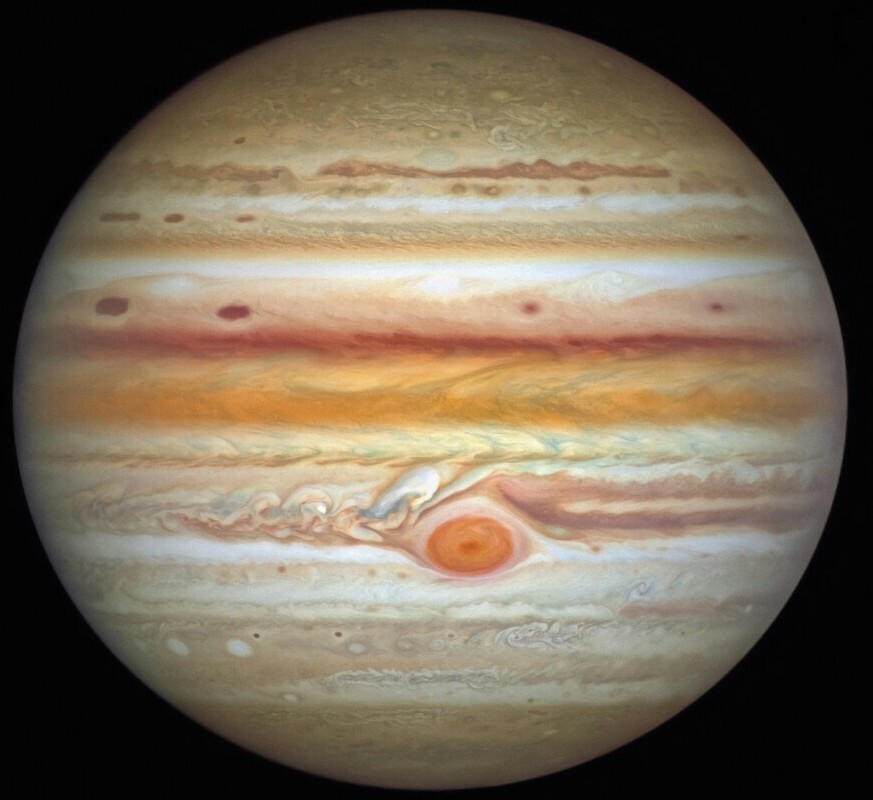
Jupiter is the largest planet in the Solar System. Its diameter is about eleven times that of Earth, and it contains more than twice as much mass as all the other planets combined.
Yet Jupiter rotates astonishingly quickly. A complete Jovian day lasts only about 9.9 hours, giving Jupiter the shortest day of any planet in the Solar System.
That rapid rotation helps drive the remarkable atmospheric activity we see through telescopes and spacecraft images.
Jupiter’s familiar light and dark bands are clouds and atmospheric currents moving around the planet in opposing directions. The darker bands are usually called belts, while the lighter regions are known as zones.
What Can a Beginner See?
Jupiter is one of the easiest planets to find because, when well placed in the sky, it is extremely bright.
With the naked eye it looks like a very bright, steady point of light.
With binoculars, something remarkable happens.
If you hold them steadily, you may be able to see tiny points of light arranged beside Jupiter. These are not stars. They are Jupiter’s four great Galilean moons.
Through a small telescope, Jupiter itself becomes a disc and the two major equatorial cloud belts may become visible.
With a little more aperture, good atmospheric conditions and careful focusing, more subtle cloud structure begins to appear.
Try It Yourself: Observe Jupiter several times over a week and sketch the positions of the four bright moons. You will see them continually changing as they orbit the planet.
The Great Red Spot
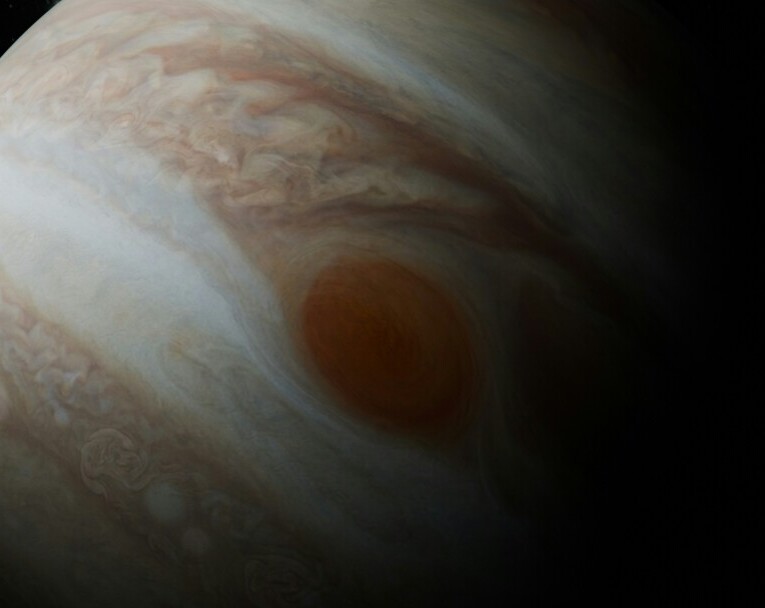
One of Jupiter’s most famous features is the Great Red Spot, a gigantic storm in the planet’s southern hemisphere.
It has been observed for centuries and remains larger than Earth, although its size has changed over time.
Seeing the Great Red Spot through an amateur telescope is possible, but it is more challenging than seeing Jupiter’s main cloud belts.
You need the Spot to be on the side of Jupiter facing Earth at the time you observe, and reasonably steady atmospheric conditions make a substantial difference.
Do not be disappointed if you cannot see it immediately. Learning to recognise subtle planetary detail takes practice.
The Galilean Moons
Jupiter has a large family of moons, but four dominate amateur observing: Io, Europa, Ganymede and Callisto.
Galileo Galilei observed these four moons in 1610, although Simon Marius observed them at around the same time. Their changing positions provided powerful evidence that not everything in the heavens orbited Earth.
- Io: The most volcanically active body known in the Solar System.
- Europa: An icy world with strong evidence for a global ocean beneath its surface.
- Ganymede: The largest moon in the Solar System, even larger than Mercury.
- Callisto: A heavily cratered world that may also conceal a subsurface ocean.
For the beginner, their greatest attraction is that you can actually watch them move from night to night.
Did You Know? Jupiter Has Rings Too
Saturn does not have a monopoly on planetary rings.
Jupiter also has a very faint ring system, discovered by Voyager 1 in 1979.
Unlike Saturn’s bright icy rings, Jupiter’s rings are extremely faint and composed mainly of small, dark particles. Much of the material is thought to be dust produced when meteoroids strike Jupiter’s small inner moons.
These rings are far too faint to be a realistic visual target for an ordinary amateur telescope, but they are a useful reminder that ring systems are not unique to Saturn.
Saturn: The Ringed World
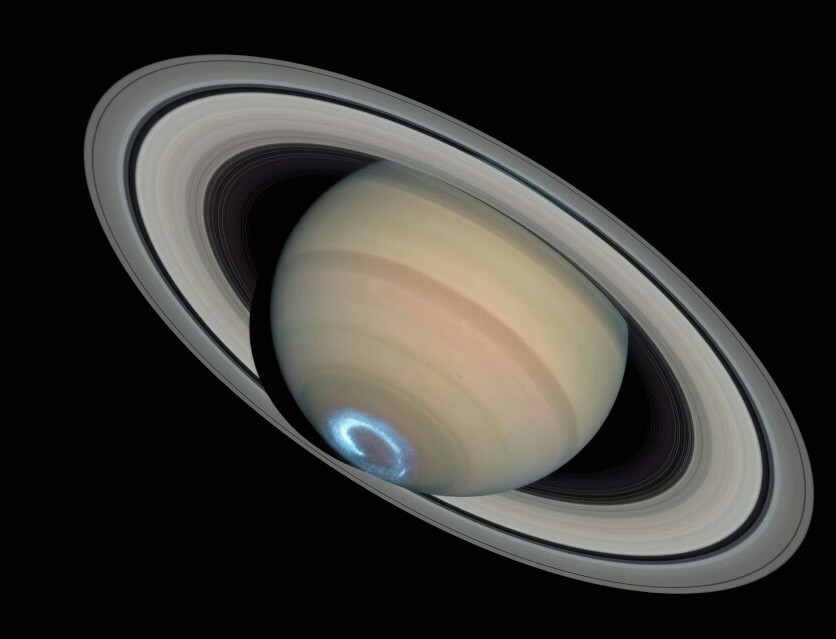
If Jupiter impresses with its size and cloud belts, Saturn provides one of astronomy’s most unforgettable sights.
Many people remember the first time they saw Saturn through a telescope.
At first glance it almost does not look real. The planet appears as a small golden globe surrounded by a clearly separate ring system.
Saturn is the second-largest planet in the Solar System and, like Jupiter, is composed mainly of hydrogen and helium.
Its atmosphere also contains powerful winds and storms, although its visible cloud bands tend to appear more subdued through an amateur telescope than Jupiter’s.
What Can a Beginner See?
Saturn is bright enough to find with the naked eye when it is well placed.
Through binoculars, Saturn generally remains too small for the rings to be clearly separated, although it may look slightly elongated.
Even a modest telescope changes everything.
At relatively low magnification, the rings become obvious. Increase the magnification gradually, and under good conditions you may begin to see more structure.
Try It Yourself: Start with your lowest-powered eyepiece to locate Saturn. Once centred and sharply focused, gradually increase the magnification. Do not assume the highest-powered eyepiece will give the best view.
Atmospheric steadiness matters enormously. On a turbulent night Saturn may shimmer and refuse to sharpen no matter how carefully you focus.
On another night, using exactly the same telescope, the image may suddenly become crisp.
Saturn’s Rings
Saturn’s rings are composed of enormous numbers of particles, dominated by ice with rocky and dusty material mixed in.
The particles range from tiny grains to much larger fragments. Despite their enormous width, the main rings are remarkably thin compared with their overall diameter.
The major visible rings are traditionally labelled A, B and C, with several fainter rings beyond them.
Between the bright A and B rings lies the famous Cassini Division, a broad darker gap.
Under favourable conditions, the Cassini Division can be seen through a good amateur telescope, although how easily depends on telescope aperture, magnification and atmospheric steadiness.
Titan and the Moons of Saturn
Saturn has an enormous family of moons, but Titan is the one a beginner is most likely to encounter first.
Titan is Saturn’s largest moon and the second-largest moon in the Solar System. It is even larger than Mercury and is the only moon known to possess a substantial atmosphere.
Through a telescope, Titan appears as a small point of light near Saturn.
Scientifically, however, it is one of the most fascinating worlds we know.
Titan has clouds, rain, rivers, lakes and seas — but they are composed mainly of liquid methane and ethane rather than water. Beneath its icy exterior, scientists also think there may be a subsurface ocean of liquid water.
Huygens: A Historic First
Titan also holds a special place in the history of planetary exploration.
On 14 January 2005, ESA’s Huygens probe descended through Titan’s thick atmosphere and landed successfully on its surface after travelling to Saturn aboard the Cassini spacecraft.
It was the first successful landing on a world in the outer Solar System.
Huygens transmitted images and scientific measurements during its descent and after landing, revealing an alien landscape shaped by processes that in some ways resemble those on Earth.
The Cassini-Huygens mission deserves an article of its own, so we will return to Huygens and its extraordinary journey in greater detail another time.
Enceladus: A Small Moon With a Big Secret
Another Saturnian moon that has become extremely important is Enceladus.
Cassini discovered that jets of water vapour, ice particles and other material erupt from fractures near its south pole.
The evidence points towards a salty ocean beneath its icy crust.
That makes Enceladus, like Europa around Jupiter, one of the most intriguing places in the Solar System when scientists consider environments that might potentially support life.
What Is Inside a Gas Giant?
Although Jupiter and Saturn are called gas giants, neither is simply a giant ball of ordinary gas.
As you descend into either planet, increasing pressure compresses the hydrogen until it behaves as a liquid.
In Jupiter, the pressure becomes so great that hydrogen becomes electrically conducting metallic hydrogen, helping generate the planet’s enormous magnetic field.
Jupiter’s central region is also thought to be more diffuse than a simple solid core, with heavier material mixed into surrounding layers.
Saturn is thought to have a dense central region containing heavier materials, surrounded by layers of hydrogen under intense pressure.
There is no solid surface on either world where a spacecraft could simply land.
Which Planet Is Better for a Beginner?
Fortunately, you do not have to choose.
Jupiter is probably the better planet for repeated observing because its atmosphere and four bright moons give you something different to watch from night to night.
Saturn provides perhaps the more dramatic first view because its rings are so unmistakable.
Both are excellent targets for small telescopes.
What You Can Look For on Jupiter
- The planetary disc.
- The two principal cloud belts.
- The four Galilean moons.
- Finer atmospheric detail under good conditions.
- The Great Red Spot when it is facing Earth and conditions allow.
What You Can Look For on Saturn
- The rings clearly separated from the planet.
- Titan as a point of light nearby.
- Subtle planetary banding under good conditions.
- The Cassini Division with suitable aperture and steady air.
A Few Observing Tips
- Allow your telescope time to adjust to the outdoor temperature before expecting the sharpest planetary views.
- Start with low magnification and increase it gradually.
- Focus carefully.
- Observe for more than a few seconds. Atmospheric turbulence comes and goes, and moments of steadier air can suddenly reveal detail that was invisible seconds earlier.
- Try sketching what you see. Drawing the position of Jupiter’s moons or Saturn’s rings encourages you to observe more carefully.
- Return to the planets repeatedly. Learning to see planetary detail is a skill.
Two Planets Every Beginner Should See
There are astronomical objects that look impressive in photographs but can initially appear disappointing through a telescope.
Jupiter and Saturn are different.
Jupiter immediately gives a beginner the chance to see another world as a real disc, accompanied by moons whose movement can be followed night after night.
Saturn offers something even more startling: a planet surrounded by rings that can be seen with your own eyes through a modest telescope.
For somebody taking their first steps into astronomy, these are not simply interesting objects to read about.
They are worlds you can go outside and see for yourself.
And that is where astronomy really begins.
Clear skies.