Uranus: The Ice Giant on Its Side
Uranus ice giant may sound like an unusual phrase, but it describes one of the strangest planets in our Solar System.
Last month we looked at Jupiter and Saturn, the two great gas giants of our Solar System. This month we travel farther from the Sun to meet two rather different worlds: Uranus and Neptune, the ice giants.
Uranus is perhaps the stranger of the two. Pale blue-green, surrounded by faint rings and accompanied by a family of icy moons, it has one characteristic that makes it unlike any other planet in the Solar System.
Uranus appears to rotate on its side.
That unusual orientation gives the planet some of the most extreme seasons we know of and has left astronomers with questions that are still being investigated.
Why Is Uranus Called an Ice Giant?
The Uranus ice giant is sometimes grouped together with Jupiter and Saturn as one of the giant planets, but astronomers describe Uranus and Neptune more specifically as ice giants.
Jupiter and Saturn are dominated by hydrogen and helium. Uranus and Neptune also possess hydrogen and helium atmospheres, but a much greater proportion of their interiors is associated with materials such as water, methane and ammonia.
The word ice can be slightly misleading. It does not mean that the inside of Uranus is simply a giant frozen block. Deep inside the planet, temperatures and pressures are enormous and these materials exist in forms very different from the familiar ice in a household freezer.
The Discovery of Uranus
Uranus has an important place in the history of astronomy because it was the first planet discovered with the aid of a telescope.
William Herschel observed it in 1781. At first he believed he may have found a comet or star, but continued observations showed that the object was travelling around the Sun as a planet.
Until then, Saturn had effectively marked the recognised outer boundary of the planetary Solar System.
The discovery of Uranus suddenly made the known Solar System much larger.
A Planet Lying on Its Side
Uranus has an axial tilt of almost 98 degrees.
Earth is tilted by about 23.5 degrees, which gives us our familiar seasons. Uranus is tilted so dramatically that it appears almost to roll around the Sun on its side.
Why this happened is uncertain. One possibility is that Uranus suffered a huge collision, or perhaps several collisions, early in the history of the Solar System.
Whatever the cause, the result is extraordinary.
Uranus takes about 84 Earth years to complete one orbit of the Sun. Because of its extreme tilt, each pole can experience years of continuous sunlight followed by years of darkness.
A Uranian season lasts roughly 21 Earth years.
Why Is Uranus Blue-Green?
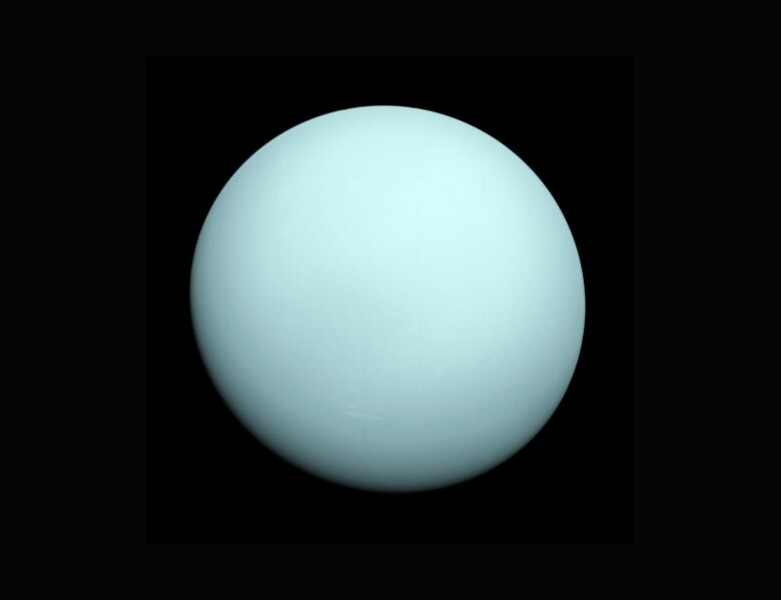
Uranus appears pale blue-green because methane in its atmosphere absorbs much of the red light from sunlight while allowing more blue and green wavelengths to be reflected back towards us.
Its atmosphere is composed mainly of hydrogen and helium, with methane and other gases present in smaller amounts.
At first glance Uranus can look almost featureless compared with the colourful bands of Jupiter or the dramatic storms of Neptune. Modern observations, however, have revealed clouds, changing weather and atmospheric activity.
The Rings of Uranus
Saturn may own the most spectacular ring system, but it is far from the only ringed planet.
Uranus is surrounded by a system of narrow, dark rings.
They are much fainter than Saturn’s brilliant icy rings and are extremely difficult to see through ordinary amateur equipment.
The rings were discovered from Earth in 1977 when astronomers watched Uranus pass in front of a distant star. The star repeatedly dimmed before and after Uranus itself crossed it, revealing previously unknown rings surrounding the planet.
The Moons of Uranus
Uranus has a fascinating collection of moons. The five major moons are Miranda, Ariel, Umbriel, Titania and Oberon.
Unlike most planetary moons, which are generally named after figures from Greek or Roman mythology, many Uranian moons take their names from characters in the works of William Shakespeare and Alexander Pope.
One of the most remarkable is Miranda.
Voyager 2 revealed a strange patchwork surface of ridges, cliffs and enormous canyons. It looks almost as though separate landscapes have been assembled into one small world.
Titania is the largest moon of Uranus, followed closely by Oberon.
We will return to the extraordinary moons of the outer Solar System in a future feature on the Moons of the Solar System.
Voyager 2 Visits Uranus
Our only close encounter with Uranus took place on 24 January 1986 when NASA’s Voyager 2 spacecraft flew past the planet.
Voyager revealed new moons, additional rings, a strangely tilted magnetic field and close-up views of the major Uranian moons.
The spacecraft passed Uranus only once and continued onwards towards Neptune. No spacecraft has returned since.
That means much of what we know about Uranus at close range still comes from a brief encounter nearly four decades ago.
Can You See Uranus From Earth?
Yes — but this is very different from finding Jupiter or Saturn.
Uranus can occasionally lie near the limit of naked-eye visibility under an exceptionally dark, clear sky, but for most observers a pair of binoculars or a telescope is a much more realistic way of finding it.
The difficulty is not simply brightness. Uranus can easily be mistaken for an ordinary faint star unless you know exactly where to look.
A current star chart or stargazing app is extremely useful.
Begin with binoculars or a low-power telescope and identify the surrounding stars. Once you are certain you have located the right object, increase the magnification.
Through a suitable telescope Uranus may show a tiny blue-green disc rather than the sharp point of light shown by a star.
Do not expect to see cloud belts or dramatic surface detail. Uranus is almost three billion kilometres from the Sun and remains a challenging visual target.
What Makes Uranus So Interesting?
Uranus presents astronomers with some major unanswered questions.
Why is its rotation so extreme? Why is its magnetic field so strangely orientated? How did its moons and rings form? What is happening deep inside the planet?
These questions matter beyond our own Solar System.
Planets similar in size to Uranus and Neptune appear to be common around other stars. Understanding our own ice giants can therefore help astronomers understand an entire class of planets elsewhere in the Galaxy.
Uranus and Neptune — The Ice Giants
Uranus is only the first of our two ice giants.
Travel farther from the Sun and we reach Neptune: darker, more distant and home to some of the fastest winds measured anywhere in the Solar System.
Continue with our feature: Neptune: The Solar System’s Distant Blue World .
You can also revisit our earlier feature on Jupiter and Saturn: The Gas Giants .
Sources and Further Information
Planetary data and mission information for this article were checked against NASA Solar System Exploration and the Voyager mission archive.
Clear skies.