Binocular Astronomy: Exploring the Night Sky Without a Telescope
When people first become interested in astronomy, they often assume that buying a telescope is the natural first step. But there is another way to explore the night sky, and it is one that even experienced astronomers continue to enjoy: binocular astronomy.
A good pair of binoculars can reveal hundreds of stars that are invisible to the naked eye, bring distant star clusters into view and allow us to explore large areas of the heavens without the complications of setting up a telescope.
For beginners, binoculars are one of the most accessible ways to begin observing. They are portable, relatively simple to use and available at a wide range of prices. More importantly, they are not merely a stepping stone towards a telescope. Binoculars are valuable astronomical instruments in their own right.
Why Use Binoculars for Astronomy?
One of the greatest advantages of binoculars is their wide field of view. Whereas a telescope often concentrates on a relatively small section of the sky, binoculars allow us to explore much larger regions.
This makes them particularly useful for observing constellations, open star clusters, the Milky Way and large astronomical objects such as the Andromeda Galaxy.
Another advantage is that we observe with both eyes. Many people find this more natural and comfortable than looking through a single telescope eyepiece.
There is also the convenience. On a clear evening, you can take your binoculars outside and begin observing within minutes. There are no complicated mounts to assemble and, with smaller binoculars, no tripod is necessarily required.
Understanding Binocular Magnification and Aperture
Binoculars are usually described using two numbers, such as 7×50, 10×50 or 15×70.
The first number indicates the magnification. A pair of 10×50 binoculars makes an object appear approximately ten times larger in angular size than it does to the unaided eye.
The second number represents the diameter of the objective lenses in millimetres. These are the large lenses at the front of the binoculars.
Larger objective lenses collect more light, which can make faint astronomical objects easier to detect. However, larger binoculars are also generally heavier, and greater magnification makes it more difficult to hold the image steady.
For astronomy, choosing the highest magnification is not necessarily the best approach. A comfortable, steady view is often more useful than a larger but constantly moving image.
Which Binocular Size Is Best?
7×50 Binoculars: Comfortable Wide-Field Viewing
Traditional 7×50 binoculars have long been popular for astronomy. Their relatively low magnification makes them easier to hold steady, while their 50mm objective lenses provide useful light-gathering power.
They are particularly enjoyable for sweeping star fields and exploring large constellations.
One example is the Celestron Cometron 7×50, which we include among the beginner-friendly models on our binoculars equipment page.
One point worth remembering is that 7×50 binoculars produce an exit pupil of approximately 7.1mm. Not everyone’s eyes can use that full diameter, particularly under light-polluted skies, so they are not automatically the best choice for everyone.
8×42 and 10×42: Portable and Versatile
For someone who wants binoculars for both daytime use and astronomy, 8×42 and 10×42 models are excellent options to consider.
They are generally more compact than traditional 50mm binoculars and are convenient for travelling, wildlife watching and casual stargazing.
The Celestron TrailSeeker 8×42 and Nikon ProStaff P7 10×42 are examples of this type already featured on our equipment page.
Although their smaller objective lenses collect less light than 50mm models of comparable quality, their portability and ease of use make them attractive choices for beginners.
10×50: A Classic Choice for Stargazing
For many amateur astronomers, 10×50 binoculars represent an excellent balance between magnification, light-gathering ability and practical handling.
They provide enough magnification to reveal considerably more detail in star clusters and on the Moon than the naked eye can show, while remaining manageable for many observers.
Examples on our binoculars page include the Olympus 10×50 S, Nikon Aculon A211 10×50, Celestron UpClose G2 10×50 and Pentax SP 10×50 WP.
If I were advising someone who wanted binoculars primarily for astronomy, 10×50 would certainly be one of the first sizes I would suggest investigating.
15×70: Moving Towards Larger Binoculars
Once we move into 15×70 binoculars, we enter a different category of observing.
The larger 70mm objective lenses collect more light than 50mm objectives of comparable transmission, while the additional magnification helps reveal smaller details and fainter stars.
The Celestron SkyMaster 15×70 is an example of this type.
However, there is an important consideration: weight and stability. Although some people can hold 15×70 binoculars briefly, a sturdy tripod or suitable binocular mount is strongly recommended for comfortable astronomical use.
With the binoculars properly supported, the improvement in steadiness can be remarkable. Stars become easier to focus on, and faint objects are less likely to disappear because of movement.
20×80 and Larger: Specialist Astronomy Binoculars
Binoculars with 80mm or larger objective lenses can provide impressive views of star fields, clusters and some brighter deep-sky objects.
But these are substantial instruments. They are heavier, have narrower fields of view than many smaller binoculars and require a suitably strong mounting system.
They can be rewarding for experienced observers, but they are not essential for beginners. The cost of the binoculars and the necessary mount should both be considered before buying.
For now, we regard these as a specialist category rather than a routine first purchase.
What Can You Actually See with Binoculars?
This is where binocular astronomy becomes particularly interesting. Even modest binoculars can transform familiar areas of the night sky.
The Moon
The Moon is an excellent first target. With binoculars, the dark lunar maria become much more obvious, and some of the larger craters and bright ray systems can be distinguished.
Try observing when the Moon is partly illuminated. The boundary between lunar day and night, known as the terminator, often reveals surface features more clearly because of the long shadows.
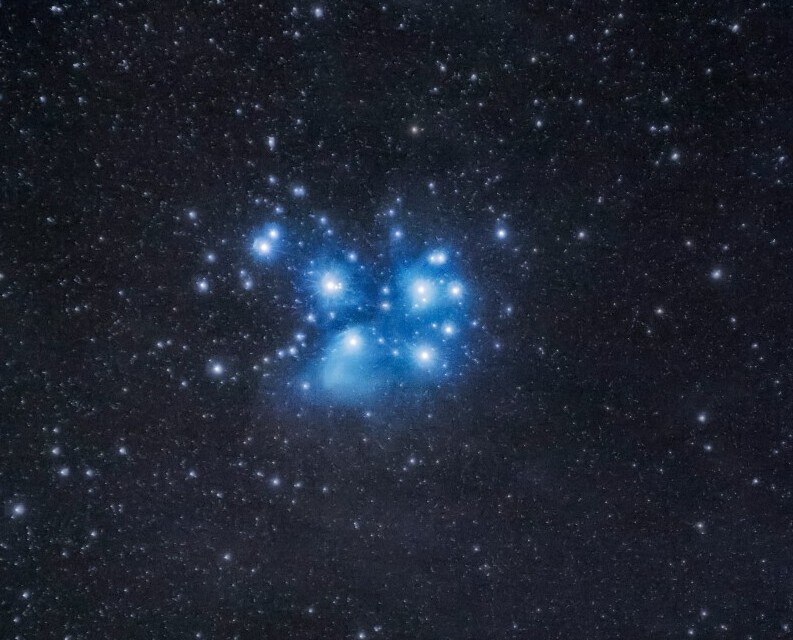
The Pleiades (M45)
The Pleiades, also known as the Seven Sisters, are among the finest binocular targets in the night sky.
Located in Taurus, this beautiful open cluster is visible to the naked eye, but binoculars reveal many additional stars.
A wide-field pair of binoculars can frame the cluster beautifully, making it an excellent target for beginners.
The Hyades
Also in Taurus is the Hyades, a large, loosely arranged star cluster forming much of the familiar V-shaped pattern associated with the Bull’s head.
Its broad appearance makes it particularly suitable for binoculars with a wide field of view.
The bright star Aldebaran appears in the same direction but is actually much closer to Earth and is not a member of the cluster.
The Orion Nebula (M42)
During the autumn and winter months, Orion becomes one of the most recognisable constellations in the UK sky.
Below Orion’s Belt lies the Sword, where the Orion Nebula can be found.
Through binoculars, the nebula appears as a small, misty patch surrounding a group of stars.
You should not expect the colourful appearance seen in long-exposure astrophotographs. Nevertheless, recognising that faint glow as a region of active star formation is a remarkable experience.
The Andromeda Galaxy (M31)
Under sufficiently dark skies, the Andromeda Galaxy is visible to the naked eye as a faint smudge.
Binoculars make it easier to identify and reveal its elongated glow.
What we see is primarily the galaxy’s bright central region, rather than the detailed spiral structure shown in photographs.
Andromeda is approximately 2.5 million light-years away, making it one of the most distant objects many beginners will observe.
The Double Cluster in Perseus
Another wonderful binocular target is the Double Cluster, consisting of NGC 869 and NGC 884.
These neighbouring open clusters form an attractive pair, particularly through binoculars that can frame both together.
They are well placed for UK observers during the autumn and early winter.

Can Binoculars Be Used to Search for Comets?
Absolutely. Larger binoculars have played an important role in the history of amateur comet hunting.
Their combination of light-gathering power and relatively wide fields of view makes them useful for searching large regions of the sky for faint, diffuse objects.
A comet may initially resemble a small, fuzzy patch of light rather than the bright, long-tailed object we often see in photographs.
Experienced observers searching for comets need a detailed knowledge of the night sky, particularly the positions of galaxies, nebulae and star clusters that might otherwise be mistaken for a new discovery.
Modern automated sky surveys now discover many comets, but amateur observers continue to make valuable contributions through observation, imaging and follow-up work.
We intend to explore this fascinating subject in a future article about amateur comet hunting and how new comets are discovered.
Getting the Best from Your Binoculars
Before beginning an observing session, there are a few simple things worth remembering.
- Choose a dark location: Streetlights and nearby buildings can make faint objects harder to see.
- Allow your eyes to adapt: Give yourself around 20 to 30 minutes away from bright lights where possible.
- Support your arms: Sitting in a reclining chair or resting your elbows can make handheld binoculars steadier.
- Use a tripod when needed: Larger binoculars, particularly 15×70 and above, benefit greatly from stable mounting.
- Learn the constellations: A star chart or astronomy app makes locating binocular targets much easier.
- Take your time: Slowly sweeping a region of sky often reveals far more than rushing between targets.
Never point binoculars towards the Sun unless they are specifically designed and correctly equipped for safe solar observation. Ordinary binoculars can cause severe and permanent eye injury when used to view the Sun.
Choosing Binoculars for Your Budget
A common mistake when starting astronomy is believing that more expensive equipment must always provide a better experience.
In reality, a well-made pair of 8×42 or 10×50 binoculars can provide years of enjoyment.
Optical quality, comfortable handling, accurate alignment and a steady image are often more important than impressive magnification figures.
If you are thinking of purchasing binoculars for astronomy, we have a selection covering beginner, general-purpose and larger-aperture models on our equipment page.
Explore our recommended binoculars for astronomy and stargazing .
Final Thoughts
Binocular astronomy reminds us that exploring the Universe does not have to involve complicated or expensive equipment.
From the craters of the Moon to the star-rich fields of the Milky Way, there is an enormous amount to discover with a simple pair of binoculars.
A telescope can certainly take your observations further, but binoculars offer something special: the freedom to explore the sky naturally, comfortably and with very little preparation.
Whether you are a complete beginner or an experienced observer, they deserve a place among your astronomy equipment.
So, on the next clear evening, take your binoculars outside, find a comfortable place to sit and spend some time discovering what the night sky has to offer.