
Apollo: Humanity’s Journey to the Moon
The Apollo missions to the Moon has a special place in the history of space exploration. It did far more than place astronauts on the Moon: it transformed an ambitious political challenge into one of humanity’s greatest scientific and engineering achievements.
The journey was filled with courage, ingenuity, setbacks and tragedy. Before the first lunar landing could take place, thousands of engineers, scientists, technicians and astronauts had to solve problems that had never been encountered before.
This is the story of how the Apollo missions developed, how the programme overcame its darkest moment, and how six successful landings changed our understanding of the Moon and our place in the Universe.
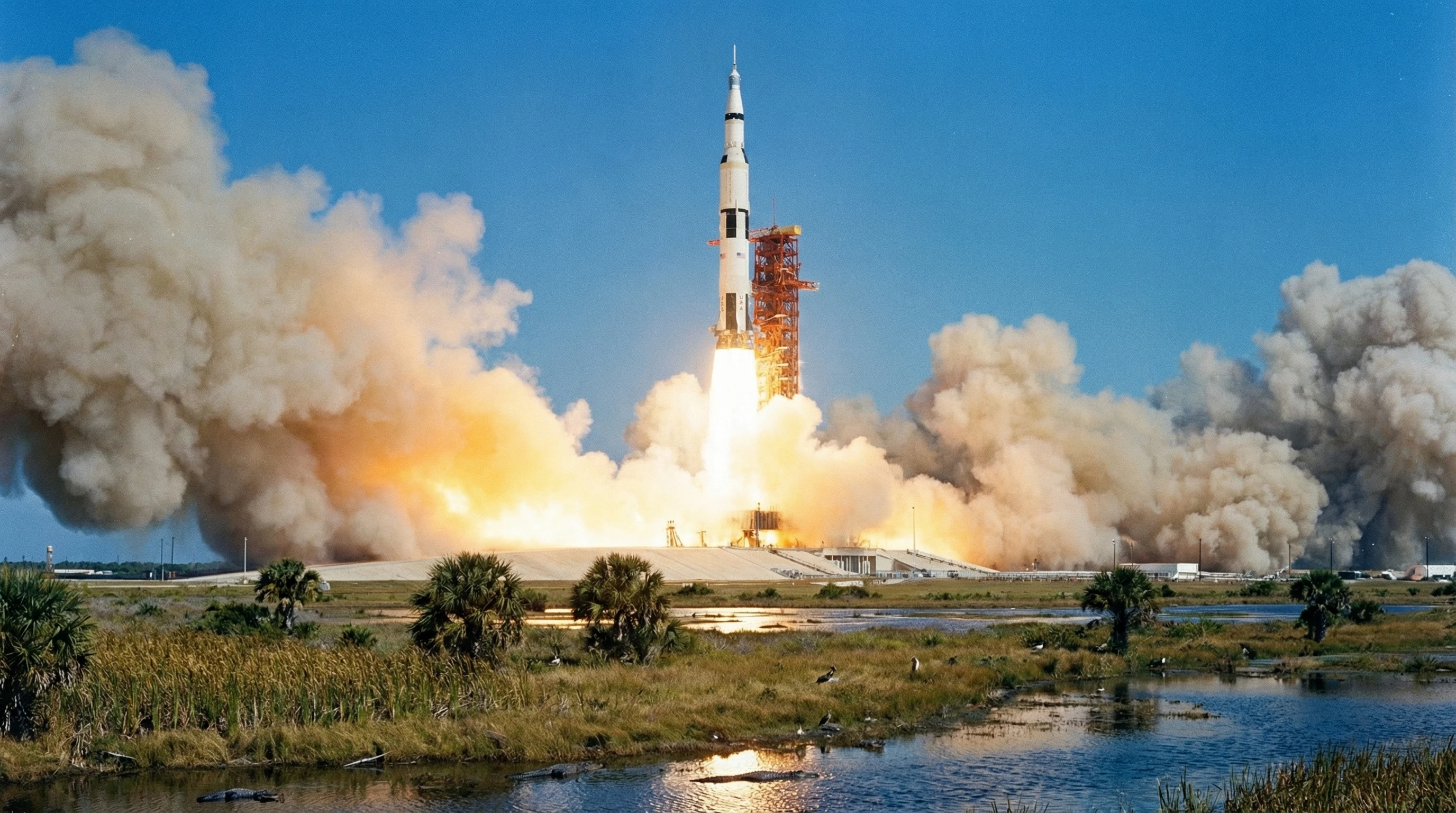
Kennedy’s Challenge
In May 1961, United States President John F. Kennedy challenged his country to land a person on the Moon and return them safely to Earth before the end of the decade.
It was an extraordinarily bold goal. At the time, the United States had achieved only a brief crewed flight into space, and many of the technologies required for a lunar mission did not yet exist.
NASA would have to develop powerful rockets, navigation computers, spacesuits, life-support systems and entirely new spacecraft. Astronauts would need to travel almost a quarter of a million miles from Earth, enter lunar orbit, land on another world and then return safely.
Kennedy’s challenge gave NASA a clear destination, but the journey towards the Moon began with two earlier programmes: Mercury and Gemini.
Mercury and Gemini: Preparing for Apollo
Project Mercury demonstrated that people could survive and work in space. Its missions tested launch systems, spacecraft controls, communications and the difficult process of returning safely through Earth’s atmosphere.
Project Gemini then developed the more advanced skills needed for a lunar mission. Gemini astronauts practised changing orbits, remaining in space for longer periods, working outside their spacecraft and bringing two vehicles together in orbit.
Those docking and rendezvous techniques would become essential during Apollo. The lunar module had to separate from the command module, land on the Moon and later return to lunar orbit to reunite with the waiting spacecraft.
Apollo 1: Tragedy on the Launch Pad
The Apollo programme suffered its darkest moment before a crew had even left the ground.
On 27 January 1967, astronauts Virgil “Gus” Grissom, Ed White and Roger Chaffee were taking part in a launch-pad test when a fire broke out inside the Apollo command module.
The fire spread rapidly through the spacecraft’s high-pressure oxygen atmosphere. The inward-opening hatch could not be opened quickly enough, and all three astronauts died.
The accident forced NASA to halt crewed Apollo flights and conduct a major review. The spacecraft was extensively redesigned, flammable materials were removed, wiring and plumbing were improved, and the hatch was replaced with one that could be opened rapidly.
Apollo 1 was a terrible loss, but the lessons learned from the tragedy resulted in important safety improvements that protected the crews who followed.
Apollo 7: Restoring Confidence
Apollo 7 launched in October 1968 and became the first crewed flight of the redesigned Apollo command and service module.
During an eleven-day mission in Earth orbit, the crew tested the spacecraft’s engines, navigation equipment, life-support systems and communications. The successful flight demonstrated that the revised spacecraft was ready for more ambitious missions.
Confidence had begun to return, but NASA’s next step would take astronauts farther from Earth than anyone had travelled before.
Apollo 8: The First Journey Around the Moon
In December 1968, Apollo 8 carried Frank Borman, James Lovell and William Anders towards the Moon.
They became the first people to escape Earth’s immediate gravitational neighbourhood, travel to another world and enter orbit around it. They were also the first humans to see the Moon’s far side directly.
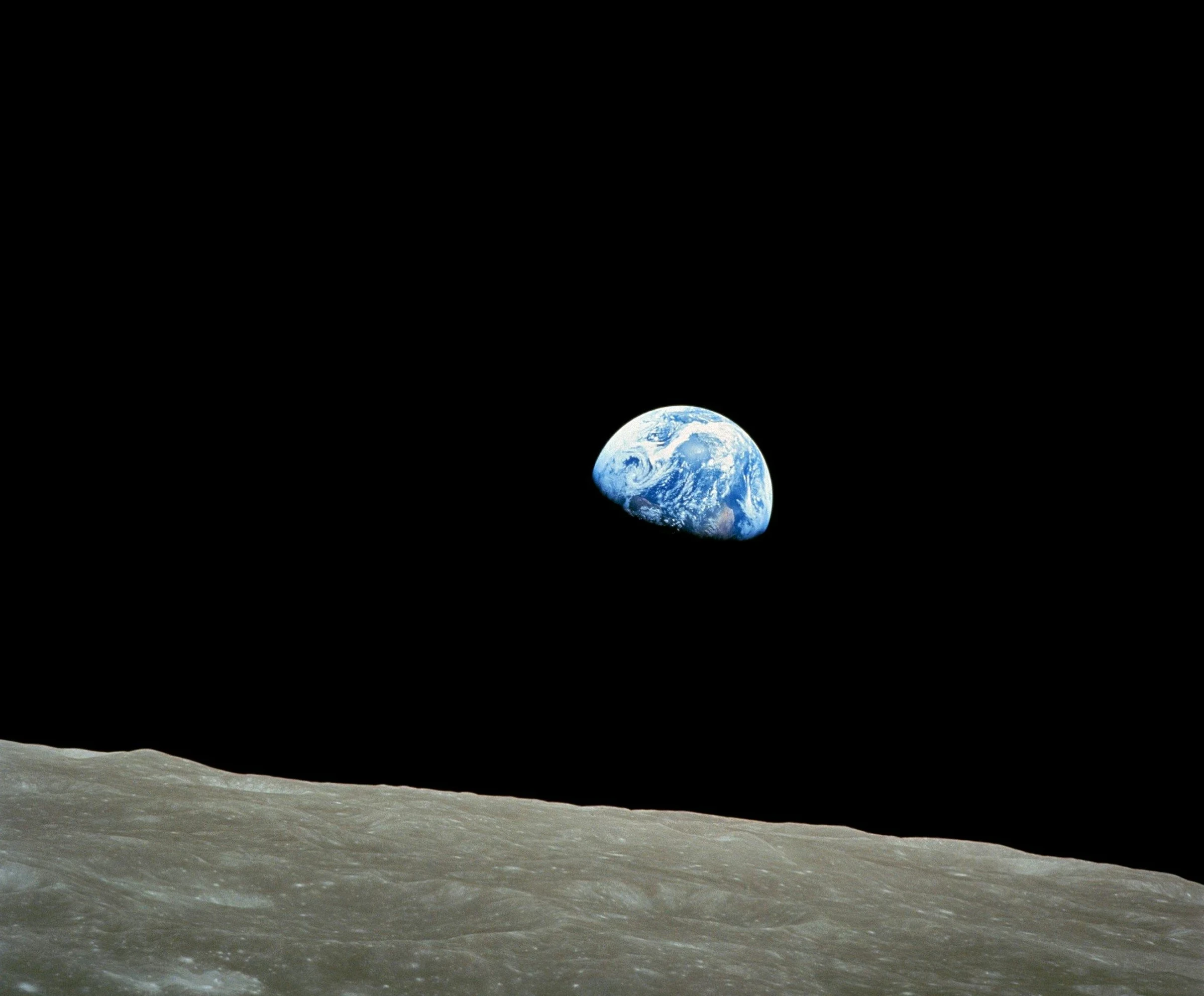
During the mission, William Anders photographed Earth rising above the lunar horizon. The resulting image, known as Earthrise, became one of the most influential photographs ever taken.
It presented our planet as a small, fragile world suspended in the darkness of space and helped many people see Earth from an entirely new perspective.
Apollo 9: Testing the Lunar Module
Apollo 9 remained in Earth orbit, but it tested one of the most important parts of the landing system: the lunar module.
The lunar module was designed to carry two astronauts from lunar orbit to the Moon’s surface and back again. During Apollo 9, the crew separated it from the command module, tested its engines and life-support systems, and then successfully docked the two spacecraft again.
The mission proved that the unusual two-spacecraft approach could work.
Apollo 10: The Final Dress Rehearsal
Apollo 10 completed almost every stage of a lunar landing without touching the surface.
The lunar module separated from the command module and descended to within approximately 15 kilometres of the Moon. The crew tested navigation, communications and the procedures that Apollo 11 would soon use during the first landing attempt.
By the time Apollo 10 returned safely to Earth, NASA had completed its final rehearsal. The next mission would attempt to land.
Apollo 11: The First Humans on the Moon
Apollo 11 launched on 16 July 1969 carrying Neil Armstrong, Buzz Aldrin and Michael Collins.
Four days later, Armstrong and Aldrin entered the lunar module Eagle and began their descent towards the Sea of Tranquillity. Collins remained in lunar orbit aboard the command module Columbia.
The descent was tense. Computer alarms sounded, and Armstrong realised that the automatic guidance system was carrying the lunar module towards a hazardous area covered in rocks and craters.
He took partial manual control and guided the spacecraft towards a safer landing site. With little fuel remaining, the lunar module touched down successfully.
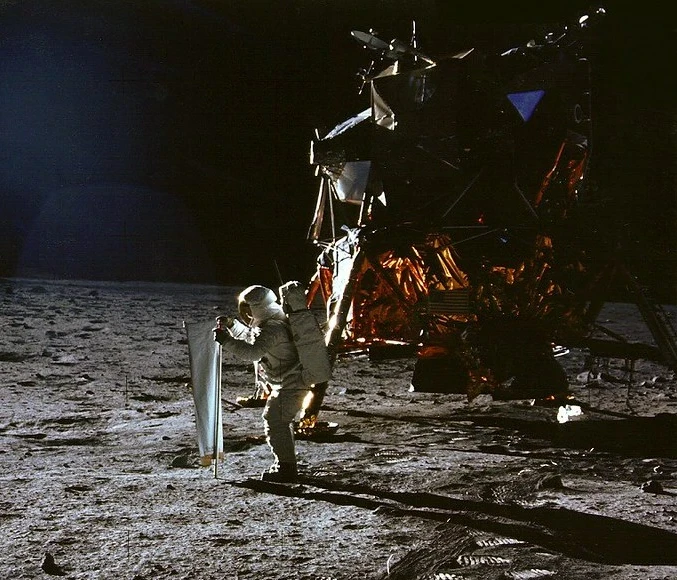
On 21 July 1969 UK time, Armstrong stepped onto the lunar surface. Aldrin joined him shortly afterwards.
The two astronauts collected samples, photographed the landing site and deployed scientific experiments. Their first moonwalk lasted a little over two hours, but its importance extended far beyond the short time they spent outside.

Apollo 11 fulfilled Kennedy’s challenge and proved that a crew could land on another world and return safely to Earth.
Apollo 12: A Precision Landing
Apollo 12 launched in November 1969 and demonstrated that the first landing had not been a matter of luck.
Charles Conrad and Alan Bean landed close to Surveyor 3, a robotic spacecraft that had arrived on the Moon more than two years earlier. The landing was remarkably accurate and showed that future crews could reach carefully selected scientific targets.
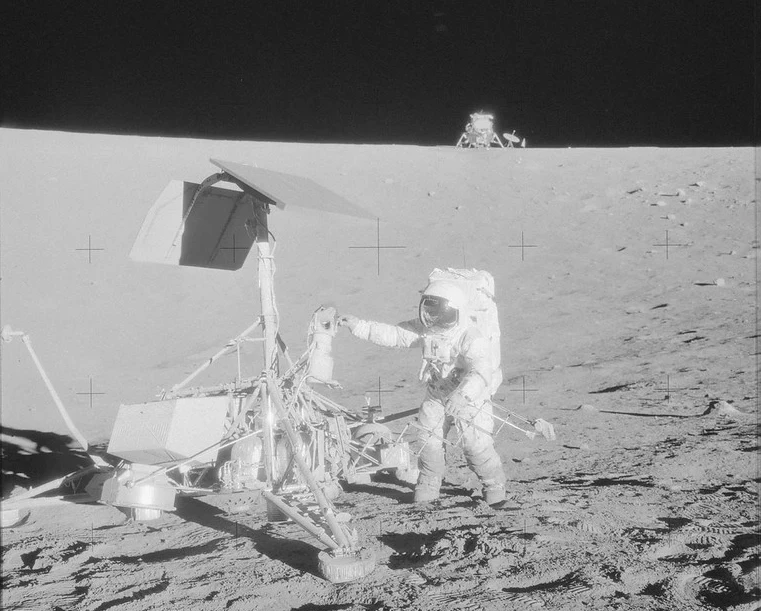
The astronauts removed parts from Surveyor 3 and returned them to Earth, allowing scientists to study how spacecraft materials had survived long exposure to the lunar environment.
Apollo 13: A Successful Failure
Apollo 13 was intended to become the third lunar landing mission. Instead, it became a dramatic struggle to bring three astronauts home alive.
An oxygen tank exploded while the spacecraft was travelling towards the Moon. The damage crippled the command module and forced the crew to abandon the landing.
The lunar module became an emergency lifeboat, supplying power, oxygen and water while the spacecraft travelled around the Moon and returned towards Earth.
Engineers on the ground worked continuously with the crew to conserve power, remove excess carbon dioxide and develop new procedures using only the equipment available aboard the spacecraft.
Apollo 13 returned safely on 17 April 1970. Although it did not land on the Moon, the mission became one of NASA’s finest examples of teamwork, calm decision-making and technical improvisation.
Apollo 14: Returning to the Moon
Apollo 14 successfully landed in the Fra Mauro highlands in February 1971, reaching the area originally intended for Apollo 13.
Alan Shepard and Edgar Mitchell collected samples, carried out experiments and attempted to reach the rim of Cone Crater.
The mission is also remembered for Shepard striking two golf balls across the lunar surface using a modified tool handle.
Apollo 15: The First Lunar Rover
Apollo 15 marked the beginning of a more scientifically ambitious phase of the programme.
David Scott and James Irwin landed near Hadley Rille and became the first astronauts to use the Lunar Roving Vehicle. The rover allowed them to travel farther from the lunar module and explore a much wider area than earlier crews.
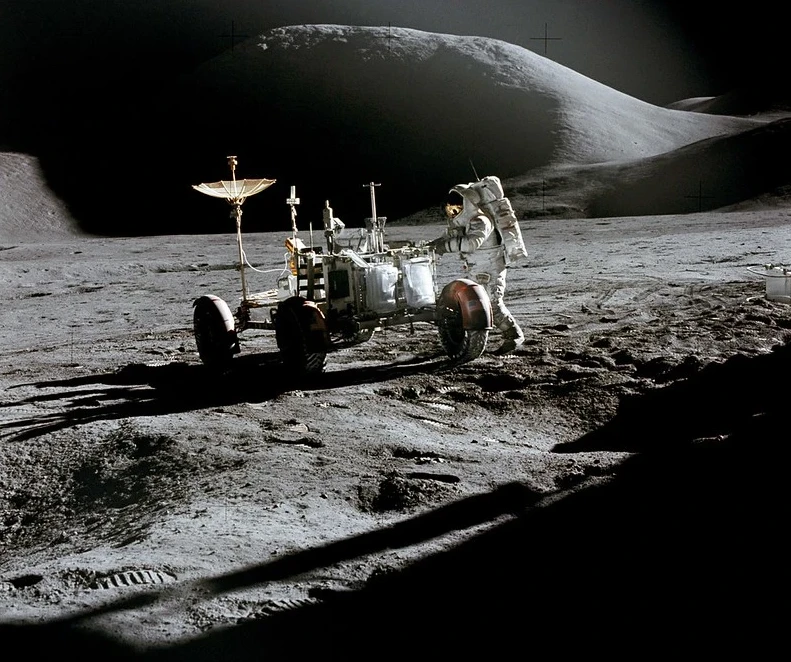
The crew collected valuable geological samples and deployed instruments that continued studying the Moon after the astronauts had departed.
Apollo 16: Exploring the Lunar Highlands
Apollo 16 landed in the Descartes highlands in April 1972.
John Young and Charles Duke used the lunar rover to explore the surrounding terrain and collect samples from a region that differed greatly from the dark basalt plains visited during several earlier missions.
The samples helped scientists understand that the lunar highlands had largely formed through impacts rather than the volcanic processes some researchers had expected.
Apollo 17: The Final Apollo Landing
Apollo 17 landed in the Taurus-Littrow valley in December 1972. It became the final crewed mission to the Moon during the Apollo programme.
The mission included Harrison Schmitt, the first professional geologist to walk on the Moon. Alongside commander Eugene Cernan, Schmitt explored the valley using the lunar rover and collected a wide variety of geological samples.
One of their most striking discoveries was orange lunar soil. The colour came from tiny beads of volcanic glass, providing evidence of ancient volcanic activity.
Before climbing back into the lunar module, Cernan became the last person of the twentieth century to stand on the Moon.
Why Apollo 18, 19 and 20 Never Flew
NASA originally planned additional Apollo missions, but Apollo 18, 19 and 20 were cancelled.
The programme was extremely expensive, public interest had begun to decline, and political priorities were changing. After the success of Apollo 11, the original goal of winning the race to the Moon had been achieved.
Funding was redirected towards other projects, including Skylab and the development of the Space Shuttle.
Some unused Apollo hardware was repurposed. A Saturn V rocket launched Skylab, while other surviving rockets and spacecraft eventually became museum exhibits.
What Apollo Taught Us
The Apollo missions returned hundreds of kilograms of lunar rocks and soil. Scientists continue to study these samples, using modern instruments that were unavailable when the material first arrived on Earth.
- Lunar science: Apollo samples transformed our understanding of the Moon’s origin, age and geological history.
- Computing: The programme helped accelerate the development and use of compact integrated-circuit computers.
- Engineering: Apollo advanced rocket design, navigation, communications, materials science and life-support technology.
- Human spaceflight: The programme developed procedures still reflected in modern spacecraft operations.
- Global inspiration: The missions demonstrated what could be achieved through a combination of ambition, investment, science and teamwork.
The lunar experiments also produced long-lasting scientific results. Retroreflectors placed on the Moon continue to allow researchers to measure the Earth–Moon distance with extraordinary accuracy.
Apollo’s Lasting Legacy
Apollo was not simply a series of flag-planting missions. Each landing increased the scientific value of the programme, with later crews remaining longer, travelling farther and carrying more advanced equipment.
The programme showed that humans could travel to another world, work there and return safely. It also demonstrated the dangers of spaceflight and the importance of careful testing, preparation and learning from failure.
Today’s plans to return astronauts to the Moon build upon the knowledge gained during Apollo. New spacecraft and technologies may be different, but the fundamental challenges of navigation, landing, survival and exploration remain closely connected to the achievements of the Apollo generation.
Frequently Asked Questions
How many Apollo missions landed on the Moon?
Six crewed Apollo missions landed successfully: Apollo 11, 12, 14, 15, 16 and 17. Apollo 13 was intended to land but was forced to return after an oxygen-tank explosion.
Why did Apollo 13 not land?
An oxygen tank exploded while Apollo 13 was travelling towards the Moon. The landing was cancelled, and the mission became an emergency effort to return the crew safely to Earth.
What did Apollo astronauts leave on the Moon?
The astronauts left lunar modules, scientific instruments, rovers, television cameras, flags and other equipment. Some retroreflectors placed during Apollo are still used for laser-ranging experiments.
Why were lunar rovers important?
The Lunar Roving Vehicle allowed astronauts on Apollo 15, 16 and 17 to travel much farther from their landing sites. This increased the amount and variety of scientific work they could complete.
Why did Apollo end after Apollo 17?
The main reasons were cost, changing political priorities and declining public interest. Funding was moved towards other projects, including Skylab and the Space Shuttle.
Final Thoughts
Apollo remains one of the greatest achievements in human exploration. Its success depended not only on the astronauts who travelled to the Moon, but also on the vast teams who designed, built, tested and controlled every part of the mission.
The programme combined imagination with practical engineering and showed that even the most difficult goals can become possible when people work together to solve each problem in turn.
More than half a century after Apollo 17 left the Moon, the footprints, equipment and landing stages remain undisturbed on the lunar surface—silent reminders of the years when humanity first learned how to travel to another world.
Continue exploring: Discover the Moon’s craters, maria and remarkable history.
Read next: The early robotic missions that prepared the way for Apollo.