Does life have to be carbon-based? It is a question that takes us far beyond the familiar world of Earth. When we look up at the night sky, we see stars, planets and galaxies stretching across unimaginable distances. We know that the Universe contains billions of galaxies, each with enormous numbers of stars, many of which have planets orbiting them.
But there is one question that has fascinated me for a long time.
If life exists elsewhere in the Universe, must it be made from the same ingredients as life here on Earth?
We tend to imagine extraterrestrial life as something at least vaguely familiar. Perhaps a microscopic organism, a plant-like structure, or even an intelligent creature with eyes and limbs.
Yet why should life elsewhere resemble anything we know?
Why Carbon?
All known life on Earth is carbon-based.
Carbon is an extraordinary element. Its atoms can form four chemical bonds, allowing them to join together in long chains, rings and complex three-dimensional structures.
These arrangements provide the foundations for the proteins, fats, carbohydrates and nucleic acids essential to living organisms.
Carbon also combines readily with other elements, including hydrogen, oxygen, nitrogen, phosphorus and sulphur.
The resulting variety of compounds makes possible the complicated chemistry on which life depends.
Water plays an equally important role in life as we know it. It acts as a solvent, allowing substances to move, react and participate in the chemical processes necessary for living cells.
Given how successfully carbon and water work together, it is understandable that scientists concentrate much of their search for extraterrestrial life on environments where this chemistry might be possible.
But does that mean it is the only possibility?
What About Silicon?
Silicon is often mentioned as a possible alternative to carbon.
There is a reason for this. Like carbon, silicon has four electrons available for forming chemical bonds, and it can form a variety of compounds.
Silicon is also abundant in the Earth’s crust and throughout rocky planets.
At first glance, therefore, it might seem a reasonable candidate for building the complicated molecules required by life.
However, there are difficulties.
Silicon does not form the same enormous range of stable, flexible molecular structures that carbon does. Its chemistry behaves differently, particularly in the presence of oxygen and water.
For example, carbon dioxide is a gas under ordinary Earth conditions, whereas silicon dioxide forms solid materials such as quartz.
These differences could present considerable obstacles to a living organism that needs to exchange materials with its surroundings and dispose of waste products.
Nevertheless, we should be careful about declaring something impossible simply because we cannot imagine how it would work.
A silicon-based organism, if one could exist, might require an environment very different from Earth.
It might also operate through chemical processes we have never encountered.
Could Other Chemicals Support Life?
We naturally associate life with liquid water because every organism we have discovered depends upon it.
But scientists have also considered whether other liquids, including ammonia or liquid hydrocarbons, could support some form of complex chemistry.
Such environments would have different temperatures, chemical reactions and physical limitations.
There is no confirmed example of life operating in this way. Indeed, we do not yet know whether any alternative chemistry could produce the organised, self-sustaining systems necessary for life.
But the possibility raises an important question.
Are we searching for life itself, or merely searching for another version of life on Earth?
Consider Saturn’s Moon, Titan
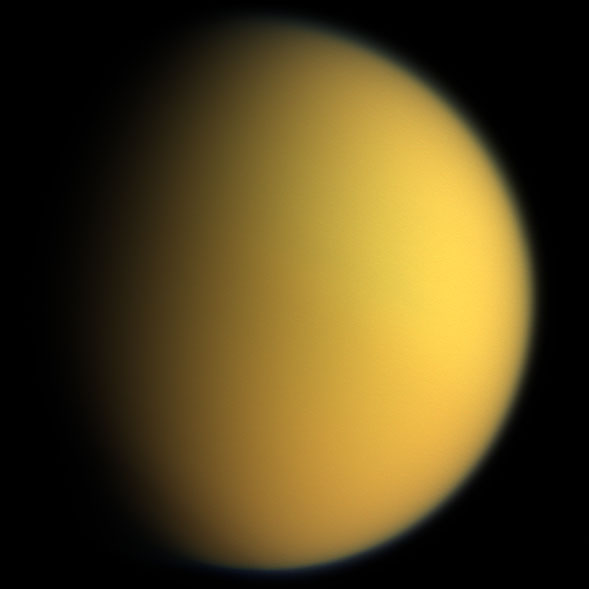
Consider Saturn’s remarkable moon, Titan. Its atmosphere contains methane and complex carbon-based compounds, while its freezing surface has lakes and seas of liquid hydrocarbons rather than water.
No life has been discovered there, but Titan demonstrates just how different an environment rich in carbon chemistry can be from our own Earth.
If two worlds containing carbon can be so extraordinarily different, how much greater might the differences be between life based on carbon and hypothetical life based on silicon?
And if such unfamiliar life exists, would we even recognise it as living?
Would We Recognise It?
This is perhaps the most intriguing part of the whole subject.
Imagine discovering something on a distant world that grows, responds to its surroundings and uses energy, but has no cells, no DNA and no chemistry that we immediately recognise.
Would we identify it as living?
Even here on Earth, defining life is not always straightforward.
Viruses, for example, possess genetic material and evolve, yet they depend upon living cells to reproduce.
Whether they should be considered alive remains a matter of debate.
Now imagine attempting to recognise life on a planet hundreds of light-years away, using only the limited information available through a telescope.
We might detect gases in its atmosphere that suggest biological activity. But geological or chemical processes can sometimes produce similar signals.
Finding convincing evidence of extraterrestrial life will therefore require great care.
And if that life is fundamentally different from anything on Earth, recognising it may prove even more challenging.
A Universe of Possibilities
We have explored only a tiny fraction of the Universe, and Earth remains the only place where life has been confirmed.
That is an important limitation.
We know carbon-based life is possible because we are here to demonstrate it. We do not yet know whether life based on another chemistry is possible.
There may be excellent scientific reasons why carbon is particularly well suited to living systems.
It may even turn out that carbon is overwhelmingly favoured wherever life develops.
But we have only one example from which to draw our conclusions.
And one example is hardly enough to describe everything that might exist in the Universe.
Final Thoughts
For me, one of the greatest attractions of astronomy is that every answer seems to lead to another question.
We have discovered planets orbiting distant stars, identified remarkable environments within our own Solar System and developed instruments capable of examining the atmospheres of worlds we may never visit.
Yet we still cannot answer one of the simplest questions of all.
Are we alone?
And perhaps there is another question we should ask alongside it.
If we are not alone, will we recognise life when we find it?
Until we have more evidence, carbon-based life remains the only kind we know.
But I would be reluctant to assume that nature has exhausted all its possibilities with us.
Something to think about the next time you look up at the stars.