Astronomy is one of the oldest sciences, attracting people who have looked up at the night sky and wondered about the stars, planets and distant lights above. If you have ever asked what those objects are, you are already following the same path astronomers have taken for thousands of years.
This beginner’s guide explains what astronomy is, why it matters, the main branches of astronomy, and how you can begin exploring the night sky yourself.
What You’ll Learn
- What astronomy is and why it matters
- The main branches of astronomy
- Useful beginner astronomy terms
- How to start exploring the night sky
- What to know before buying your first telescope
What Is Astronomy?
Astronomy is the scientific study of everything beyond Earth’s atmosphere. It includes the Sun, Moon, planets, stars, galaxies, nebulae, comets and every other object that exists in the Universe. It is one of the oldest sciences, with people observing the night sky for thousands of years.
Long before telescopes were invented, ancient civilisations carefully watched the movements of the Sun, Moon and stars. These observations helped them measure time, develop calendars, navigate across land and sea, and understand the changing seasons.
Today, astronomy combines observation with physics, chemistry and mathematics to explain how the Universe began, how stars and galaxies evolve, and what may lie beyond the limits of our current knowledge.
Why Study Astronomy?
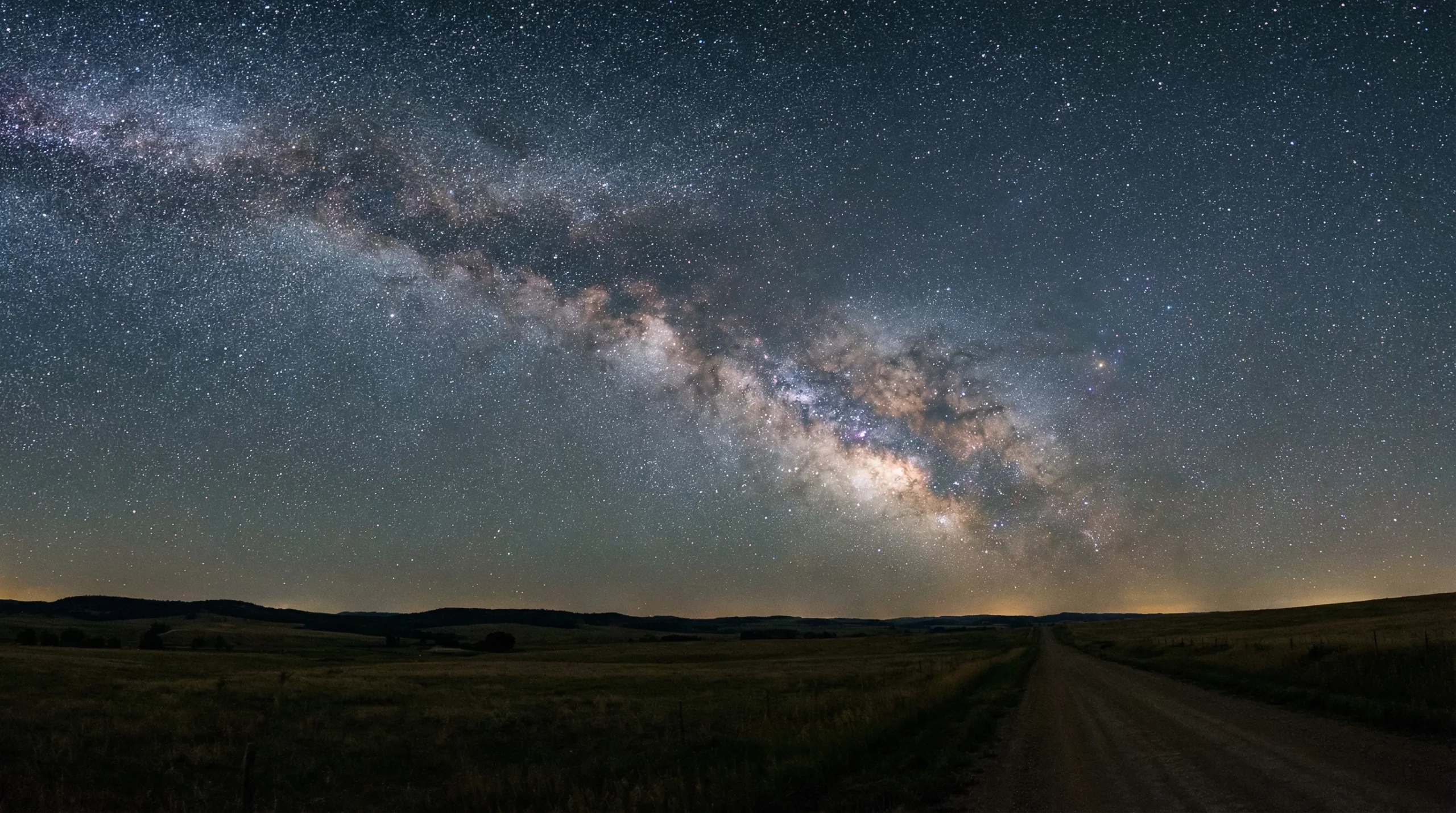
Astronomy helps us understand our place in the Universe. By observing stars, planets and galaxies at different stages of their lives, astronomers can piece together the story of how the Universe has evolved over billions of years and how our own Solar System came to exist.
It also helps answer some of humanity’s biggest questions. How was the Universe formed? Are we alone? How will our Sun change in the future? What will eventually happen to the Earth? By studying distant stars and galaxies, we are effectively looking through time, allowing scientists to understand the past and predict what may happen in the future. Much of what we know about our own Solar System comes from observing similar processes taking place elsewhere in the Universe.
For amateur astronomers, the rewards are just as exciting. Every clear night offers the chance to witness the same Universe that professional astronomers study. Whether you are observing the craters of the Moon, the rings of Saturn, a distant galaxy or the faint glow of a nebula, each observation helps you develop a deeper understanding of the cosmos and your place within it.
The Main Branches of Astronomy
Astronomy is a broad science covering many different areas of study. While all astronomers share a common interest in understanding the Universe, many specialise in particular subjects.
Observational Astronomy involves studying celestial objects using telescopes and other instruments. This is the branch most familiar to amateur astronomers, who observe the Moon, planets, star clusters, nebulae and galaxies.
Theoretical Astronomy uses mathematics, physics and computer modelling to explain how astronomical objects form, evolve and interact throughout the Universe.
Planetary Science focuses on the planets, moons, asteroids and comets within our own Solar System, while also studying planets orbiting distant stars.
Stellar Astronomy examines the birth, life and death of stars, from vast stellar nurseries to white dwarfs, neutron stars and black holes.
Galactic Astronomy explores the structure and evolution of galaxies, while Cosmology studies the Universe itself, including its origin, expansion and ultimate future.
Astronomy Fact
The light from some of the galaxies we see tonight began its journey towards Earth millions — or even billions — of years ago. Looking into space is also looking back in time.
Useful Astronomy Terms for Beginners
Light-year: A light-year is the distance light travels in one year. It is a measure of distance, not time.
Constellation: A constellation is a recognised pattern of stars in the night sky. Examples include Orion, Ursa Major and Scorpius.
Exoplanet: An exoplanet is a planet orbiting a star outside our Solar System.
Redshift: Redshift happens when light from a distant object is stretched as that object moves away from us. Astronomers use this to study the expansion of the Universe.
Supernova: A supernova is a powerful explosion that can occur at the end of a massive star’s life.
Observing Tip
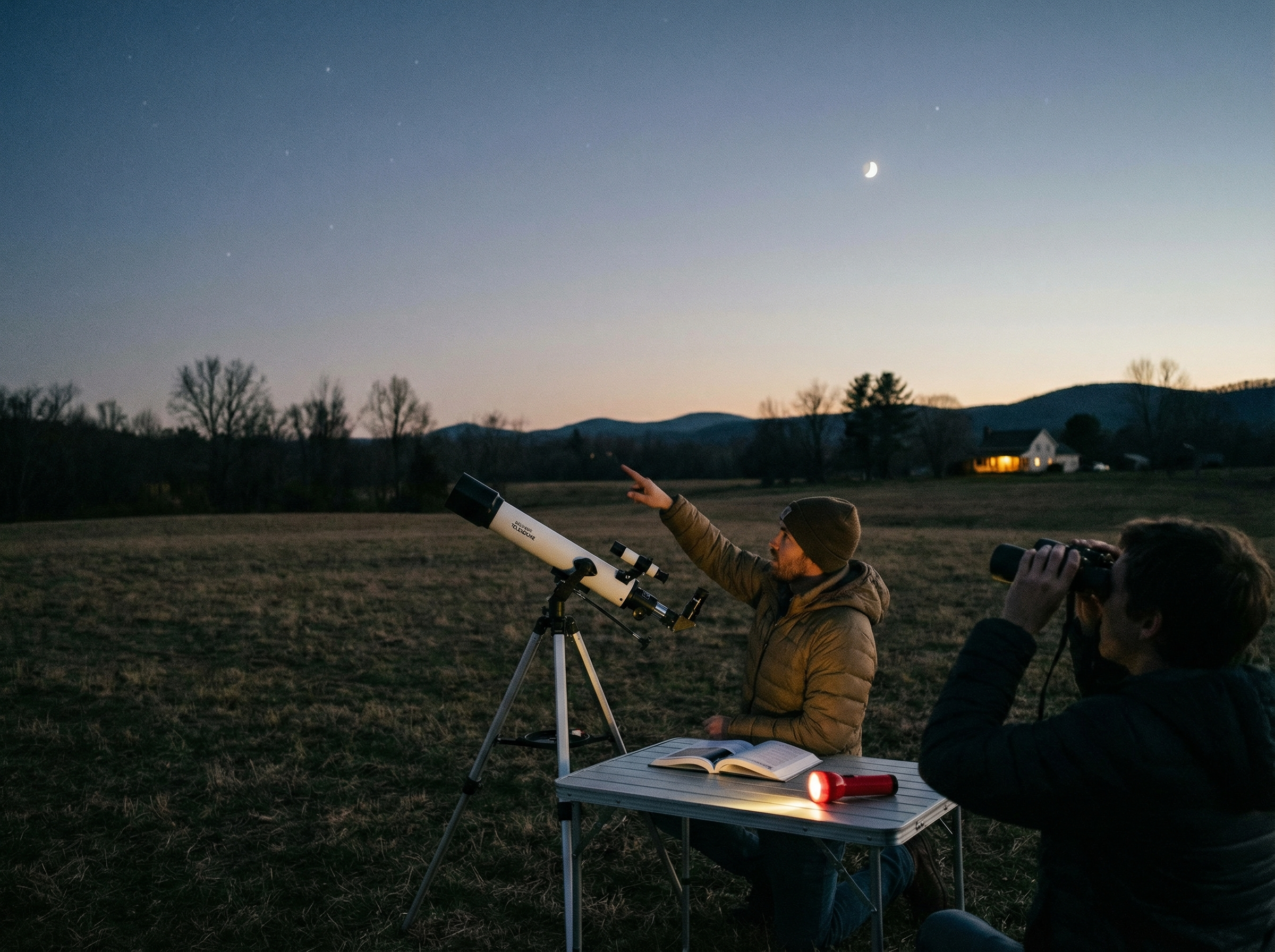
You do not need expensive equipment to begin astronomy. Start by learning the Moon, bright planets and major constellations with your eyes or a simple pair of binoculars.
How to Start Your Astronomy Journey
The best way to begin is simply to go outside on a clear night and look up. Try to identify the Moon, the brightest planets and a few well-known constellations.
A free star chart app can help you work out what is overhead. Binoculars are also a very good first step because they are affordable, portable and easy to use.
A good pair of binoculars can reveal lunar craters, star clusters and the moons of Jupiter. For many beginners, binoculars are less intimidating than a telescope and easier to use straight away.
Is Astronomy an Expensive Hobby?
Many people think astronomy requires expensive telescopes, but that is one of the biggest misconceptions. You can begin with your eyes, a star chart app or a simple pair of binoculars.
Things to Know Before Buying a Telescope
It is tempting to buy a large telescope straight away, but beginners are usually better off choosing equipment that is easy to set up and use.
Learning curve: Telescopes take practice. You need to learn how to align, focus and aim them properly.
Portability: Bigger is not always better. If a telescope is too heavy or awkward, it may not get used often.
Light pollution: City lights can hide faint stars and galaxies. The Moon and bright planets are still visible, but darker skies reveal much more.
Maintenance: Some telescopes need occasional cleaning or alignment. This is not difficult, but it is worth understanding before buying.
The Three Main Telescope Types
Refractor telescopes use lenses. They are simple to use, need little maintenance and are good for the Moon, planets and bright objects.
Reflector telescopes use mirrors. They often offer more aperture for the money and are good for faint deep-sky objects such as nebulae, galaxies and star clusters.
Catadioptric telescopes use a combination of lenses and mirrors. They are compact and versatile, although they are often more expensive.
Common Challenges in Astronomy
Astronomy is a rewarding hobby, but beginners should expect a few challenges.
Cloudy skies are part of the hobby. Patience is important, especially in the UK.
Fast-moving objects such as satellites, meteors and the International Space Station can cross the sky quickly.
Dim objects such as galaxies and nebulae can be difficult to see, especially from light-polluted areas.
Cold nights are common. Warm clothing, gloves and a hot drink can make observing much more comfortable.
Taking Astronomy Further
Once you understand the basics, there are many ways to take astronomy further.
You might try simple astrophotography using a smartphone or DSLR camera. You could follow meteor showers, eclipses and planetary conjunctions. You may also want to join an astronomy club or take part in citizen science projects.
Astronomy can be as simple or as advanced as you want it to be. Some people enjoy casual stargazing, while others move into imaging, equipment testing or detailed observing logs.
Frequently Asked Questions
Is there life on other planets?
No direct proof of life beyond Earth has been found yet, but astronomers have discovered thousands of exoplanets. Some orbit in regions where conditions might allow liquid water to exist.
Can I see planets with the naked eye?
Yes. Venus, Mars, Jupiter and Saturn can all be seen without a telescope when they are well placed in the sky.
What is the difference between astronomy and astrology?
Astronomy is a science based on observation, measurement and evidence. Astrology is not a science and claims that the positions of celestial objects influence human lives and personalities.
Getting Started
Astronomy opens up a new way to appreciate the Universe. Whether you are identifying constellations, observing the Moon, using binoculars or buying your first telescope, there is always something new to discover.
Start simply. Step outside on a clear night, look up, and begin learning your way around the sky.
Continue Your Journey
Recommended Equipment
If you are just starting out, you may also find our beginner telescope recommendations, eyepiece guide, and essential accessories helpful.